

With Jonas Gahr Støre as Prime Minister, the population of Norway has increased by more than 200,000. The growth is due exclusively to immigration. 8 out of 10 immigrants under Støre as Prime Minister come from non-Western countries. The low employment rate among these increases the pressure on Norwegian public finances.
This is how Statistics Norway (SSB) researcher Erling Holmøy described, in Finansavisen in the spring of 2013, the consequences of non-Western immigration.
SSB was clear that the economic effects of immigration must be analysed. For in the last issue of the publication Samfunnsspeilet that year, the conclusion was clear:
The Brochmann Commissions
Statistics Norway had prepared the economic analysis that formed the basis for the first Brochmann Commission’s official report in 2011.
In 2017, the second Brochmann Commission, led by Professor Grethe Brochmann, presented a new official report.
A recurring concept was “absorption capacity”. This is described as society’s capacity to absorb immigration without it producing the consequences Holmøy described above, or causing trust in society to weaken.
In the meantime, we had had the migration wave of autumn 2015, which caused the government to prepare a supplement to the state budget for 2016, owing to the record-high flow of migrants from Asia and Africa.
 Supplement to the state budget for 2016. Source: Regjeringen.no
When the Brochmann Commission delivered its second report in 2017, it was clear that absorption capacity, and the acceptance of exceeding it, is a question that it left to politicians to decide. Since then, little has happened.
The replacement
Since publication, these reports have gathered dust in the ministry’s archives. The advice has not been followed up, and the political parties have not presented any absorption capacity that they believe is responsible for the society they have been elected to govern and adopt budgets for.
Nor are there any signs that the Støre government relates to the concept or the conclusion in these reports.
It appears rather that Støre has made into prevailing policy what SSB calls a sin of omission. The consequence is a demographic development moving in the direction of a replacement of the original population in Norway.
At the beginning of 1991, the year the Soviet Union collapsed, Norway’s population numbered 4.2 million people. First- and second-generation immigrants constituted 4 per cent, of whom half were from Africa and Asia, and only 1 per cent came from Islamic countries.
20 years later, when the first “Brochmann report” came, in the spring of 2011, Norway’s population had increased to 4.9 million. The proportion with an immigrant background had risen to 12 per cent. 6 percentage points were from Africa and Asia, and 3 percentage points came from Islamic countries.
At the beginning of 2026, Norway’s population had passed 5.6 million. Fully 22 per cent now have an immigrant background, of whom 10 per cent are from Africa and Asia. 6 per cent of the population originate from Islamic countries. The definition of Islamic countries is countries that are members of the OIC – Organization for Islamic Cooperation, which counts 57 countries, primarily in Asia and Africa.
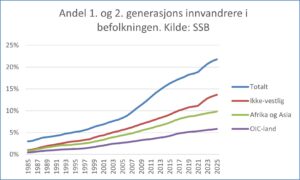 The proportion of first- and second-generation immigrants in the population. OIC = Organisation of Islamic Cooperation. Source: SSB
The trend is clear. With it, public expenditure as a share of the Norwegian economy increases. This must be financed through increased taxes and greater use of oil revenues. The consequences that Holmøy described back in 2013 appear to be a reality.
Costly replacement
From 2021 to the end of 2025, the number of inhabitants in Norway increased by 202,000 persons. 99 per cent of the increase is due to immigration and the excess of births among immigrants. The growth is distributed as 83 per cent immigrants and 16 per cent Norwegian-born descendants.
The last percentage point is linked to the majority population with Norwegian-born grandparents. Increased life expectancy partly compensates for lower birth rates. But that tendency is ebbing out. The growth can be explained by third-generation immigrants being included in the group.
One factor that has made itself felt with the Labour Party in government is that hundreds, probably more than a thousand, affluent people with high tax contributions have left the country with their financial assets and business ideas.
8 out of 10 new citizens under Støre have a non-Western background. The weighted employment rate for immigrants with corresponding country backgrounds in the 20–66 age group is only 58 per cent. This stands in sharp contrast to the employment rate among native Norwegians, which is 80 per cent.
200,000 new inhabitants with an employment rate a full 22 percentage points lower than that of the majority population have economic consequences for the welfare state, as formulated by Holmøy.
If we take full-time employment as our starting point, the picture becomes even bleaker. The volume-weighted full-time employment of the immigrant groups to which the new arrivals belong is only 38 per cent.
This is the conclusion from SSB’s latest figures for population and employment, published in March 2026.
The figures are taken from SSB tables 05183, 05184, 11609 and 12550.
This means that fewer than four out of ten of working age have a job from which they can support themselves. This in turn means a disproportionately increased burden on the welfare state, whose financing burden is distributed among ever fewer people. Holmøy’s consequence analysis from 2013 emerges clearly.
Too easy simply to point to Ukraine
The usual explanation for the high immigration figures during the Støre period, and the challenges associated with them, is the influx of Ukrainian war refugees. But this is far from explaining the whole picture. Admittedly, the Ukrainian diaspora has increased by 80,000 during these four years, and that has cost money. But the number of inhabitants with an immigrant background has increased by 200,000.
Fully 65,500 of the population increase is explained by African and Asian migrants, of whom 44,600 are immigrants and 20,900 are Norwegian-born descendants.
If we take the Ukrainians out of the equation, the remaining part of the population growth nevertheless ends up with an employment rate of 68 per cent, part-time or full-time, and only 50 per cent full-time employment. For the answer to be otherwise would require these migrants to have higher competence and better capacity for work than their compatriots who have already arrived.
The following table shows the employment rate for various immigrant groups aged 20–66, where full-time employment is lower than 50 per cent, sorted from highest to lowest full-time employment rate.
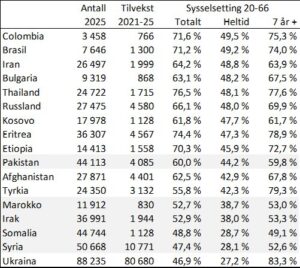 Employment rate sorted by lowest full-time employment. Source: SSB
It is not surprising that the large arrival of Ukrainians has led to a low employment rate. The column furthest to the right, however, shows the employment rate among immigrants who have seven years of residence or more, which is one of the criteria for citizenship. There Norwegian-Ukrainians do particularly well, with an employment rate of over 83 per cent, which is higher than for the population without an immigrant background.
In contrast to this are those who have a background from countries such as Syria, Somalia, Iraq, Morocco and Pakistan. Even with seven years of residence or more, the percentage employment rate nevertheless remains down in the 50s. Somalis, who are the largest African immigrant group, do not even manage 50 per cent, even after seven years of residence, and full-time employment is below 30 per cent. Common to these countries is that they are Islamic.
Every tenth inhabitant is from Africa or Asia
After 35 years of a liberal implementation of the immigration stop, Norway has over the past 35 years acquired a rapidly growing minority from Africa and Asia which now numbers 552,000 people. This means that every tenth inhabitant in Norway has a background from an Asian or African country.
324,000 of this minority originate from Islamic countries in these parts of the world. It is also this group that lies at the bottom of the employment statistics, as shown in the table above.
The volume-weighted average employment rate for these, in the 20–66 age group, with 7 years of residence or more, is 54 per cent for Africans from Islamic countries and 58 per cent for Asians from Islamic countries.
For comparison, the employment rate for the majority population is 80 per cent in this age interval.
When one reads SSB’s conclusion from 2013 on the economic effects of immigration, one sees a clear connection between the demographic development and the growth in public budgets, and that there is little doubt about the need to analyse the economic effects of immigration.
However, we give the last word to Professor of Sociology Grete Brochmann. In the article “Expects greater inequality”, which appeared in Klassekampen on 11 September 2015, she stated:


