
 Espen Teigen
A major study shows how Norwegian youths are exposed to violence, abuse, robbery and harassment on a scale we have never before seen documented.
Nearly 7,000 youths aged 12 to 16 have answered questions about their experiences with crime, violence, abuse and harassment. The responses paint a picture of a youth existence in which fear and vulnerability characterise everyday life for a great many.
The report “Safe and Young” has been carried out by the Norwegian Centre for Violence and Traumatic Stress Studies (NKVTS) on behalf of the Ministry of Justice and Public Security.
- 1 in 4 girls have been subjected to robbery in the past year, compared to 18 per cent of boys.
- 1 in 4 boys have been beaten up in the past year (serious physical violence).
- 1 in 4 girls have been subjected to digital sexual violations.
- 15 per cent of girls have been subjected to sexual abuse by peers, 8 per cent among boys.
- 45 per cent of all youths aged 12–16 plan their movements to avoid crime.
Girls are the most exposed
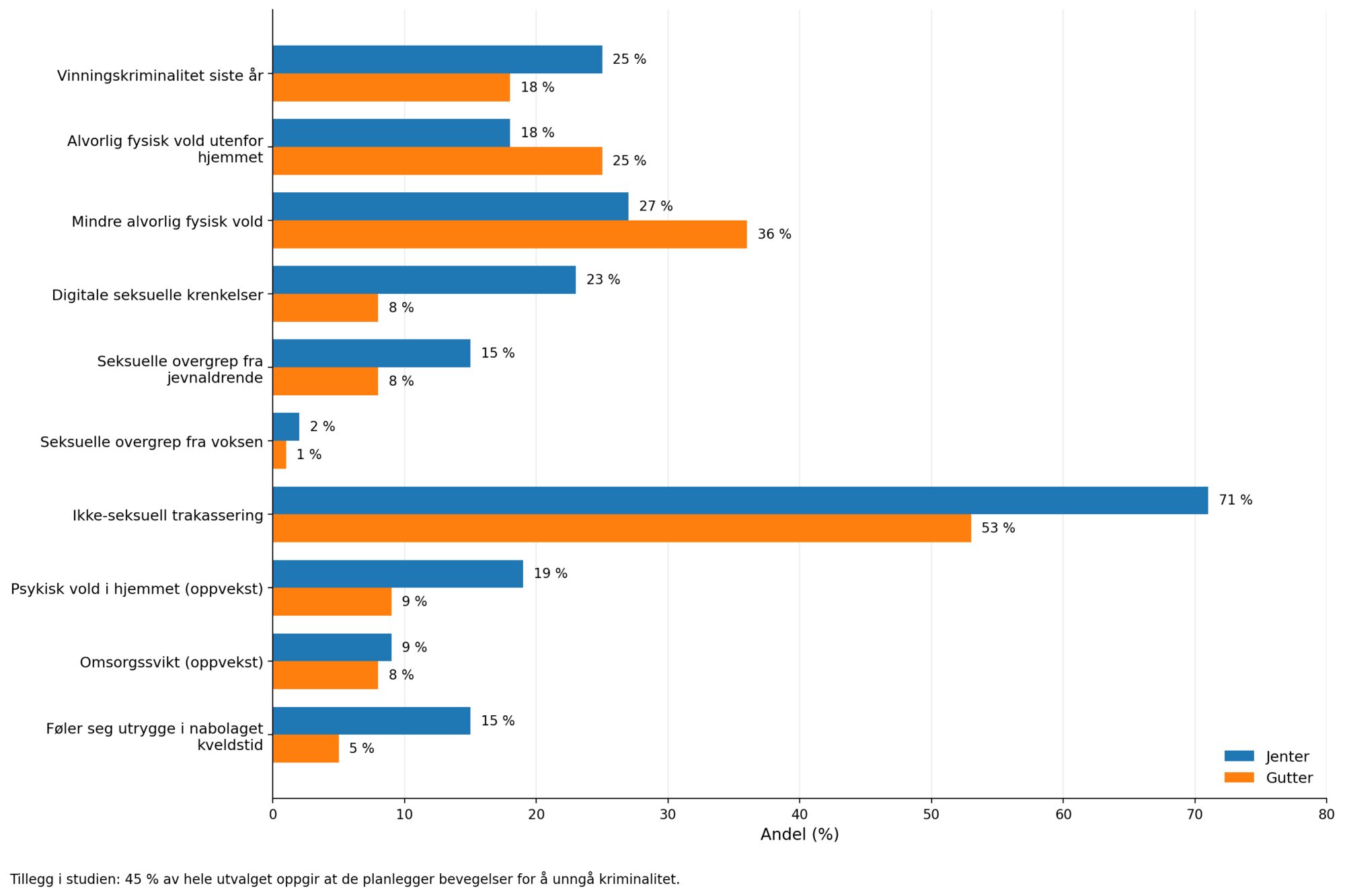
The figures are disheartening. One in four girls (25 per cent) report having been subjected to acquisitive crime such as theft, fraud, identity theft or robbery in the past year. Among boys, the proportion is 18 per cent.
Even more alarming are the figures for violence. 18 per cent of girls and 25 per cent of boys report having been subjected to serious physical violence outside the home in the past year. This involves kicking, blows with a fist or a hard object, or being beaten up.
23 per cent of girls report having been subjected to digital sexual violations and abuse. 15 per cent of girls report sexual abuse and violations by peers, while 2 per cent have experienced physical sexual abuse by an adult.
Plan everyday life around crime
One of the most striking findings is that 45 per cent of the youths report that they plan when and where they go in order to avoid being subjected to crime.
15 per cent of girls say they feel unsafe in their own neighbourhood in the evening, compared to 5 per cent of boys. Concern about digital violations is the most widespread, and is reported by 14 per cent.
These are not figures from a major city abroad. This is Norwegian youth, in Norwegian schools, in Norwegian neighbourhoods.
Non-sexual harassment is the most common form of exposure. 71 per cent of girls and 53 per cent of boys report having experienced this in the past year.
Peers are identified as the most common perpetrators, but a smaller proportion report exposure from adults.
The youths remain silent
A consistent finding is that youths to a very limited extent tell anyone about what they are subjected to. They do not tell parents, friends or professionals. Very few incidents are reported to the police.
This means that a large proportion of crime against Norwegian youth never becomes visible in any statistics. The justice system and support services are never made aware of it. The dark figures are, in other words, enormous.
The researchers behind the study point out that youths often do not know where the boundary lies between “ordinary” experiences and criminal offences. Fighting and teasing may in many cases be regarded as part of youth life, but may also involve serious violence and grave violations.
The study also shows a clear connection between what happens in the home and exposure outside it. 19 per cent of girls and 9 per cent of boys report psychological violence in the home during upbringing. 9 per cent of girls and 8 per cent of boys report neglect.


