

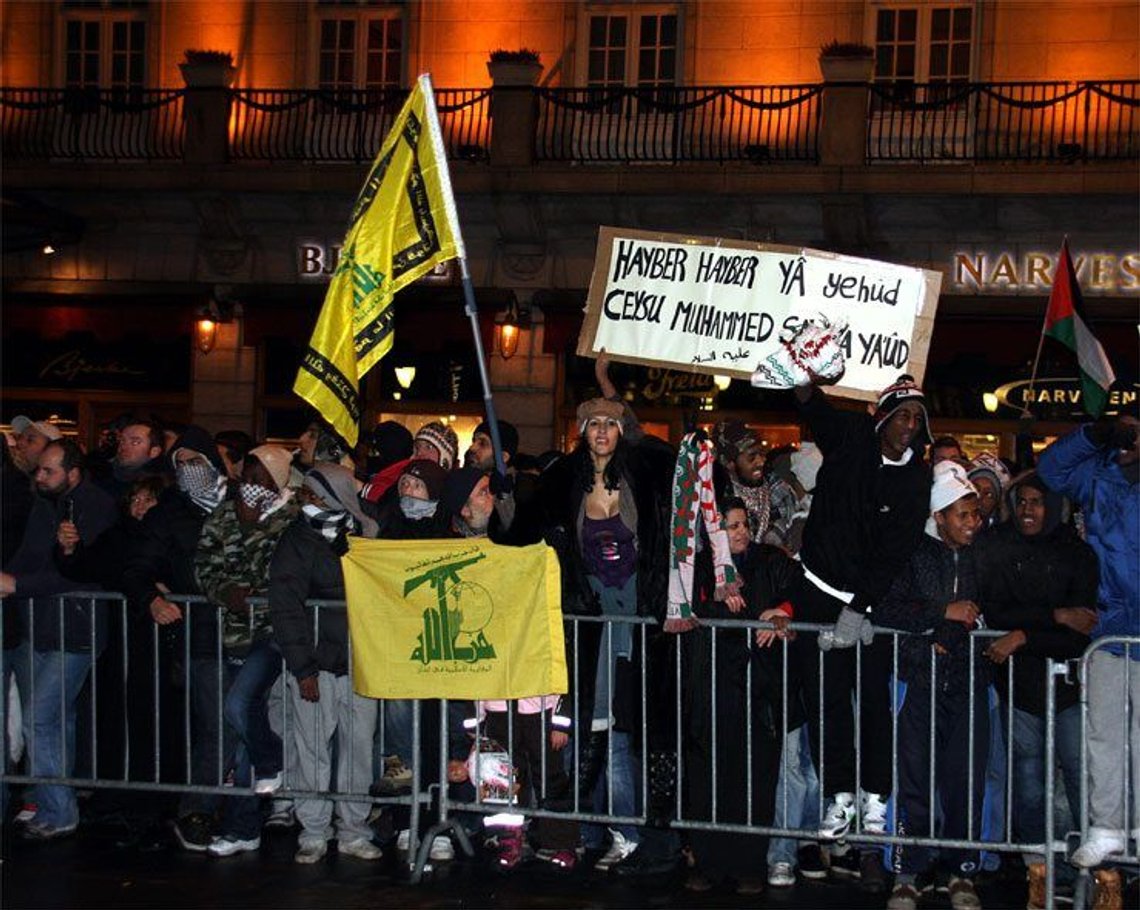
“Our communities around the world have encountered levels of antisemitism that few of us alive today have experienced. These are now days that Holocaust survivors say remind them of Europe’s darkest time.” Rabbi Menachem Margolin.
A new national opinion poll in the United Kingdom, commissioned by the Union of Jewish Students (UJS), now reveals the extent of the antisemitism crisis at British universities. The survey, conducted by JL Partners among 1,000 students, paints a bleak picture of everyday life on campus. In response to the report ‘Time for Change’, UJS is now calling for immediate cross-party measures to combat hatred of Jews.
The main findings of the report are alarming:
- Glorification of terror: Nearly half of students (49%) report the glorification of Hamas or Hizbollah on campus, and 47% have seen the 7 October attacks being justified.
- Extreme rhetoric: 26% consider calls for the removal of “Zionists” from campus acceptable, while 16% believe the claim that “Jews control the media and the government” is not antisemitic.
- Normalisation of harassment: 23% of students have witnessed abuse directed specifically at Jewish fellow students.
- Social exclusion: One in five students (20%) express reluctance to share accommodation with a Jew.
- Academic disruption: 69% of students dislike protest methods that disrupt teaching.
Testimonies in the report describe a daily life marked by strained friendships, social exclusion and physical assaults. UJS President Louis Danker emphasises that antisemitism is no longer isolated incidents, but a normalised condition:
“This report shows that antisemitism on campus is not isolated incidents, but something that is becoming normalised. No Jewish student should have to experience social exclusion, insults or physical violence. There is a right to protest, but not to harass.”
The report reveals a striking gap between British educational institutions in general and the prestigious Russell Group universities. At these institutions, as many as 79% describe the debate climate surrounding the Israel–Palestine conflict as “toxic or threatening”. Fear of participating in political debate is almost twice as strong here as at other institutions.
The crisis is also spreading in the United States
The situation is no better on the other side of the Atlantic. Despite hearings in Congress, a report from the House of Representatives (March 2026) shows that leadership at American universities still hesitates to undertake a clear reckoning with antisemitism and violence against Jews. Hostility appears to be legitimised by certain faculty members and radical groups such as “Students for Justice in Palestine”.
On 10 March, the Anti-Defamation League (ADL) published its annual report, which showed some improvement in universities’ policies since 2024: Of 150 institutions surveyed, 58% received a grade of A or B this year, compared with 41% in 2025 and 23.5% in 2024.
Although the Anti-Defamation League (ADL) sees some improvement in universities’ formal policies, this has not affected student attitudes. Nearly half of non-Jewish American students (47.6%) now express at least one anti-Jewish position.
The report, which is based on responses from 1,007 non-Jewish American students, shows that university measures have not yet changed students’ attitudes:
- 48.3% have seen or experienced anti-Jewish behaviour in the past year.
- 47.6% expressed at least one anti-Jewish position.
- 19.2% expressed three or more such positions.
Both in the United Kingdom and the United States, universities struggle to draw a clear line between legitimate political debate and the glorification of terror, threats, exclusion and antisemitism. The lack of action affects students’ sense of security. This tendency is also reflected in national politics. Despite rising antisemitism and threats against Western Jews, it appears that Western politicians either lack the will or the ability to act.
“Never again” is under pressure
This development must be seen in a broader European context. Rabbi Menachem Margolin, Chairman of the European Jewish Association (EJA), recently stated that Jewish communities today are facing levels of hatred that recall Europe’s darkest days. He points out that Jews in Belgium now require protection by armed soldiers, and that many choose to move to Israel – even though Israel is in the midst of a war – because they feel safer there than in Europe.
“We are living in a time when the promise of ‘Never again’ has not been fulfilled”, Margolin warns. He describes a reality in which Jewish communal life must take place behind bulletproof doors:
“In the past two and a half years, 902 days since the terrible attack on Israel on 7 October 2023, it is not only Israel that has been under attack. Our communities around the world have encountered levels of antisemitism that few of us alive today have experienced. These are now days that Holocaust survivors say remind them of Europe’s darkest time.
We have gone through everything: hatred online, lies and propaganda, vandalism of Holocaust monuments, antisemitic propaganda in our streets, attacks on synagogues by all possible means, even explosions. Tragically, we have lost members of the community, friends and family.
Jews today face verbal harassment and antisemitism from people who feel comfortable expressing hatred towards them. Jews have been physically attacked across Europe simply for speaking Hebrew or for looking Jewish. Our communal life must take place behind fences and bulletproof doors.
In Belgium, there is now a need for armed soldiers to protect Jewish communities – hundreds of soldiers who are not deployed to fight a war, but to protect the inhabitants of a European country from other inhabitants who wish to harm them simply because they are Jewish.
In just the past three weeks, since the joint Israeli-American operation against Iran, there have been more than a dozen attacks on Jewish communities and synagogues that only by a miracle did not result in loss of life.
We, the Jewish people, are resilient; we are strong and united, but we are living in frightening times. Times in which we are constantly reminded that the promise of “Never again” has not been fulfilled.
We are living in a time in which Jewish communities must continually ask for protection, and urge our authorities to do what they can to protect their citizens.
Over the past two and a half years, I have heard from many about the fear of living in Europe, in the countries where they were born – countries they call home. Many have decided to leave; many have chosen to move to Israel in the midst of a war, because they felt that in a war zone it was in fact safer for them than in Europe.
On the other hand, I have heard many in our communities say: We will not let them frighten us away from our homes. This is our home, this is where we want to live, and we will stand up for our right to live safely here.
I want to say to you all: You are not alone. We are here with you and for you. We will continue to fight for our safety, for our way of life, and against antisemitism. Be strong.”
Geopolitical existential struggle
The October massacre and the ongoing conflict with the Iranian regime have triggered a global wave of antisemitism and violence against Jews, particularly in the West. The alliance between Western radical forces and Islamist movements suggests a shared end goal: the elimination of the Israeli state. It is a tragic paradox that Israeli military progress appears to correlate with an intensification of hatred of Jews internationally.
While Europe appears marked by security-political despondency, the United States and Israel stand as the primary defenders against Iran’s expansionist and apocalyptic ideology. History teaches us that existential threats sometimes require resolute action rather than passivity.
From a historical perspective, it may be argued that a more decisive American leadership in the 1930s could have limited the scope of the Holocaust. It is in this light that the present situation must be seen: by confronting the Iranian regime and its ideological offshoots in the West, one seeks to prevent a historical repetition.
History will judge the leaders of our time on whether they were able to stand up against the forces that today threaten the Jewish people and the world at large. Here, Trump and the United States play a decisive role in countering these dark forces.


