
 Afshin Bagherpour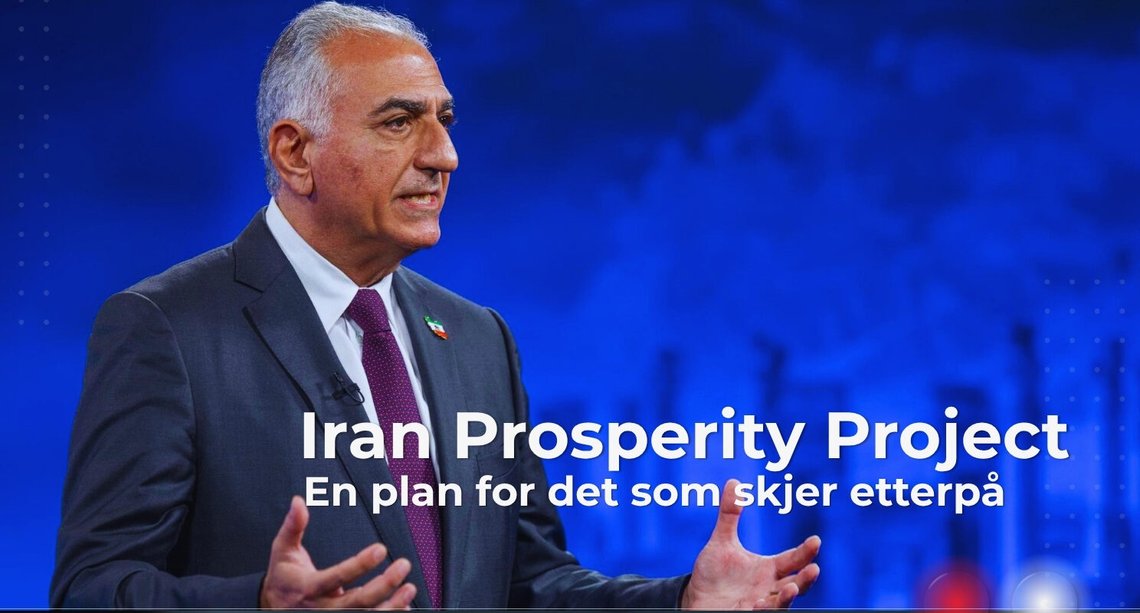
After 47 years of a regime that has controlled every single institution in Iran, the decisive moment will not be when it falls – but what fills the vacuum afterwards. It is not enough to abolish a regime. A revolution must also be managed further, and a state must be sustained in its most vulnerable moment.
It is precisely this perspective that Crown Prince Reza Pahlavi has brought to the fore.
It is often spoken of Iran’s future in general terms. Of democracy, freedom and rights. Less often of what in practice determines whether any of this can be realised: what happens in the days and months following a regime’s fall.
In this landscape, Crown Prince Reza Pahlavi has taken the initiative for a body of work that stands out in both scope and ambition. Through his network of professional environments and experts, he has contributed to assembling and structuring what is today known as the Iran Prosperity Project – a comprehensive and detailed framework for a transition after the regime.
For Norwegian authorities, this is not a distant question. A collapse in Iran will have direct consequences for European security, migration, energy markets and regional stability. Experience from the Middle East shows that the consequences of failed transitions are rarely geographically contained.
The decisive question is therefore not whether change will come – but whether it is prepared.
A plan for what happens afterwards
The Iran Prosperity Project is not a slogan, but a concrete and publicly available plan. It is developed to manage the most critical moment: the transition. The plan is divided into phases and extends over 18–24 months, but must be understood on two levels.
The first 180 days are decisive. This is the stabilisation phase – the period in which the state either survives or collapses. The focus is not political reform, but control and continuity. The security apparatus must be consolidated, fragmentation prevented, and basic functions such as electricity, banking, salary payments and supply lines must be maintained.
This also entails managing the most sensitive structures in the state, including armed and economic power organs, in order to prevent them from developing into parallel centres of power. Temporary governing structures must be established rapidly, with clear responsibility and decision-making authority.
Without this, the remainder of the process will be irrelevant.
The subsequent transition period builds on this stabilisation. Only then can administration be consolidated, the legal system function, and institutions be reformed. Legal continuity is a guiding principle – the state must function before it can be changed.
At the same time, the economy must be stabilised. Confidence in the banking system and the currency must be restored. The foundation for investment and normal economic activity must be secured before more extensive reforms can be implemented.
Free elections and clarification of the form of government form part of the final phase of the transition period. Before this, a legal framework, functioning institutions and a certain degree of stability must be in place.
This is not a postponement of democracy. It is a prerequisite for democratic processes to be carried out in practice.
The plan also stands out in its breadth. It is structured in modules that reflect how a state actually functions in practice. Security, economy, administration, the judiciary, health and infrastructure are not treated in isolation, but as interdependent systems that must be stabilised in parallel.
In the security module, particular emphasis is placed on consolidating the monopoly on force under national control and preventing armed structures from developing into rival power centres. At the same time, the economic component outlines concrete measures to stabilise the currency, secure the functioning of banks and restore confidence in the market – before more extensive reforms are initiated.
The legal and institutional framework follows the same logic. Continuity is prioritised where necessary for stability, while mechanisms for reform and accountability are established. Taken together, the plan does not appear as a political document, but as an attempt to manage a complex transformation of the state with a level of detail and realism rarely present in such contexts.
The decisive moment
The transition phase is not an interlude. It is the very test of whether a state survives. Critical societal functions are not maintained by intentions alone. They require structure, coordination and responsibility.
The experience is clear.
Libya after 2011 shows what happens when the state collapses along with the regime. The security apparatus fragmented, and power was taken over by militia groups.
In Syria, the absence of a coordinated transition led to fragmentation of territory and control among various actors. The state in practice ceased to function as a unified entity.
The contrast can be found in Eastern Europe.
In Poland, Lech Wałęsa led a structured transition with clear timeframes and institutional continuity. In Czechoslovakia, Václav Havel functioned as a unifying figure, while the state was reformed – not dismantled. In Hungary, Miklós Németh contributed to a controlled transformation in which the state continued to function while the system was changed.
The difference was not ambition. It was preparation.
Criticism that misses the point
No transition can be carried out without friction or unforeseen events. The question is not whether challenges will arise, but whether they are met with structure or improvisation.
The claim that a structured transition model represents a path towards a new authoritarian rule is based on a fundamental misunderstanding of what a transition period actually is – and what it is not.
First, this criticism overlooks the distinction between temporary responsibility and permanent power. A transition structure is precisely defined by its temporal limitation and its purpose: to stabilise the state and lay the foundation for institutions that will subsequently take over. It is not an alternative to democracy, but a prerequisite for democracy to be established at all.
Secondly, the criticism presupposes an idealised scenario in which power is spontaneously distributed evenly at the moment a regime falls. History shows the opposite. In the absence of a coordinated structure, power is rapidly consolidated by the most organised actors – often without democratic legitimacy and without accountability. It is precisely in such vacuums that new authoritarian structures arise.
Furthermore, it is a fallacy to assume that the temporary concentration of decision-making authority automatically entails personal concentration of power. The transition model is based on functional structures, not personal control. Responsibility is distributed among institutions and professional environments precisely to avoid arbitrary governance. To reduce this to the power of one person is to overlook both the complexity of the plan and the reality of how modern state governance functions.
It is also worth noting that the same environments that warn against “concentration of power” have often themselves been organised around closed and centralised structures over a long period of time. When principles are applied selectively, they lose some of their explanatory force.
Ultimately, the argument rests on an implicit assumption that the absence of structure is a safer alternative. It is not. Without a plan, without lines of responsibility and without coordination, the risk is not less concentration of power – but more unpredictable and less legitimate power.
A strategy – not merely a vision
Crown Prince Reza Pahlavi appears in this context as a leader with direction. Over several decades, he has worked purposefully for Iran’s future, with particular emphasis on what happens after a regime’s fall. He has highlighted the transition period as the most critical moment – a phase in which everything can be lost without a plan, structure and direction.
In a situation in which many offer slogans, he offers a strategy.
A question of responsibility
A possible regime change in Iran will not only be a national matter. It will have direct consequences for Europe.
A structured transition reduces risk. The absence of such a plan increases it.
Democracy cannot be organised in a vacuum. It must be built upon a functioning state. This is not a theoretical discussion, but a question of responsibility.
The author writes on behalf of the think tank Maximum Support For Iran, which works on analysis, public debate and advocacy related to developments in Iran and the region.


