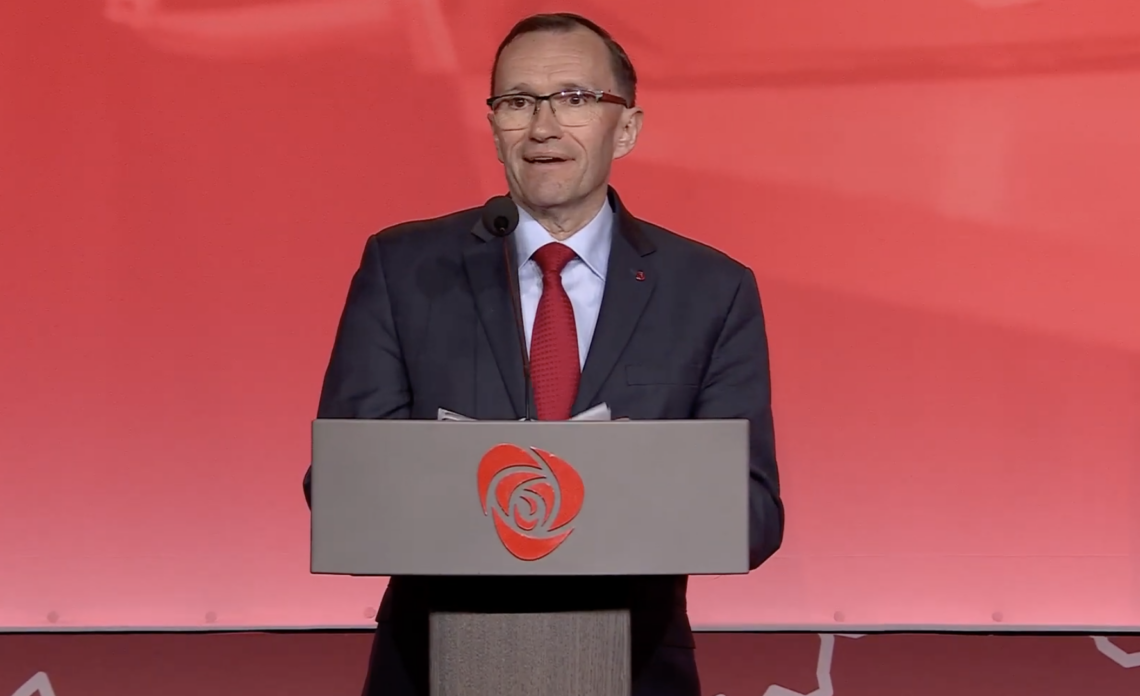
Minister of Foreign Affairs Espen Barth Eide says it is not relevant for Norway to contribute militarily to safeguard shipping through Hormuz. Some twenty countries have signed a declaration that they will contribute, but for many the offer remains unspecified. Iran threatens to mine the Strait of Hormuz if the United States proceeds with a landing. A large armada is on its way, including the amphibious ship USS Boxer and several thousand marines. There is talk of taking control of the coastline.
If the enemy attacks Iran’s coast or islands, all approaches to the Persian Gulf will be closed with sea mines, warns the Iranian defence council.
The warning on Monday comes after the American website Axios reported that the United States is allegedly considering occupying the island of Kharg in an attempt to pressure Iran into reopening the Strait of Hormuz. The island houses Iran’s most important oil export terminals.
– Any attempt by the enemy to attack Iran’s coast or islands will naturally, and in accordance with established military practice, lead to the mining of all approaches in the Persian Gulf and along the coasts, the Iranian defence council says in a statement.
– In this case, the entire Gulf will in practice be in a situation resembling the Strait of Hormuz for a long time. One must not forget that more than 100 minesweepers in the 1980s failed to remove a couple of sea mines, the statement continues.
The defence council further reminds that ships belonging to states with which Iran is not in conflict can today only pass through the Strait of Hormuz by coordinating their passage with Iran.
Iran closed the Strait of Hormuz to almost all shipping after the United States and Israel initiated their war of attack against Iran on 28 February. That, and the attacks on energy infrastructure, have led to a global energy crisis.
It is symptomatic that NTB views the matter from an Iranian perspective:
There is growing concern that the United States may deploy special forces in the war. According to the news agency AP, they could in that case go ashore either to occupy islands or other territory in Iran in an attempt to reopen the Strait of Hormuz. Israel has also indicated that the war may involve a ground operation.
The stock markets are rising today, and that is probably partly due to Trump’s threat to bomb the hell out of Iran’s power plants. In that case, Iran has nothing to lose.
US President Donald Trump threatened over the weekend to attack Iran’s power plants if the Strait of Hormuz is not reopened by Monday evening. Iran has responded with its own threat against power plants supplying US bases in the Persian Gulf.
On Monday, Iranian media published a list of such power plants, and this list included, among others, the Barakah nuclear power plant in the United Arab Emirates. On the list, which has been relayed by news agencies with close ties to the authorities, are also desalination plants in the Middle East.
Throughout the war, Iran has responded to the constant Israeli-American escalation with what it calls «corresponding retaliation». In practice, this means that Iran has attempted to respond to the opponent’s air strikes by trying to attack the same type of targets in US-allied neighbouring countries in the Persian Gulf and in Israel. Israel lies at the nearest some 1000 kilometres from Iran.
The result has been that Iran has alienated its neighbours and has no goodwill left.
Norway could have provided minesweepers. That would have been appreciated, but Norway pursues a consistent pacifist line.
The late American diplomat John C. Ausland wrote an article in the Herald Tribune during the first Gulf War. He said that Norway was content to wipe up others’ blood, and felt satisfied with that. Not much has changed since then.
Secretary General Mark Rutte says they were informed of the attack on Iran, but could not inform the member states as that would have compromised the timing. Since then, he has been working to achieve a joint effort.