

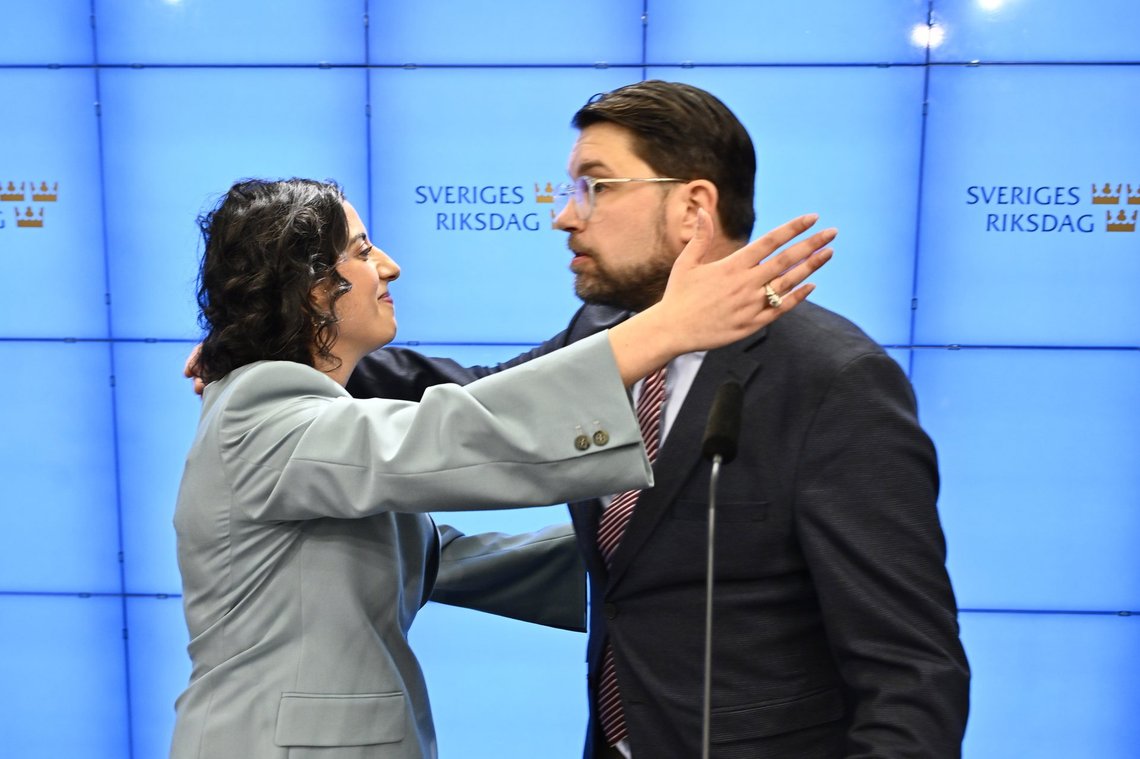
When the leader of Sweden’s Liberal Party, Simona Mohamsson, announced that she would be open to accepting the Sweden Democrats in a future government, she marked a clear political shift. The statement broke with the party’s previous position of never participating in a government that included the Sweden Democrats.
In itself, this is nothing unusual in politics. Parties regularly reassess their positions. What did stand out, however, was the way some critics reacted.
Reactions from the left
The reactions from parts of the political left were immediate and forceful—and revealed something more than simple disagreement. They exposed a deeply rooted identity-driven worldview in which individuals are reduced to their background.
People with immigrant backgrounds are expected to think and act according to a template defined by the political left, and any deviation from that template is treated almost as a form of betrayal.
Strandhäll’s comment
Former Social Democratic minister Annika Strandhäll expressed this perhaps most clearly when she wrote on X:
“Looking at yourself in the mirror tonight, given Mohamsson’s background, should be challenging.”
The remark quickly drew criticism—and it is easy to understand why. What exactly did Strandhäll mean?
That a person with Palestinian and Lebanese family roots should not be able to accept cooperation with the Sweden Democrats? That certain individuals, because of their background, are expected to hold specific political views? That people with immigrant backgrounds should promote left-wing positions, especially on issues such as migration, nationalism, and relations with Jimmie Åkesson?
If so, this perspective comes dangerously close to the identity-based notion that individuals are not truly individuals, but representatives of their group—an idea commonly referred to, however overused the term may be, as racism.
A direct response
The Liberal Party’s press chief in Gothenburg, Abraham Staifo, went even further. According to him, Strandhäll’s comment was not just problematic but outright racist. He responded:
“Either you think like a Social Democrat, or you’re just a ‘blatte.’ Damn it.”

When the individual becomes a problem
The criticism highlights a deep paradox within Swedish identity politics.
For decades, the red-green left has presented itself as anti-racist champions, standing firmly against those who reduce individuals to skin color, origin, or religion.
But when people with immigrant backgrounds refuse to follow the expected script and do not act as Strandhäll and others anticipate, the same political forces suddenly seem to reason in exactly the way they claim to oppose. The independently thinking individual is then seen as having “betrayed their background.”
The logic becomes:
A person with a certain background should hold certain political views.
If they do not, it becomes a moral problem.
Is there really any other way to describe that line of reasoning than as racist?
Revealing reactions
Simona Mohamsson’s political position can, of course, be debated and criticized. That is the nature of politics. But when criticism is framed in terms suggesting that her background should make cooperation difficult, it reveals something about the critics themselves.
In that worldview, people are not primarily individuals.
They are parts of a collective—representatives of an identity.
And anyone who breaks with the expectations tied to that identity is seen as a defector. An “Uncle Tom.” Someone who betrays their own and abandons both ideals and principles.
Mohamsson – a true liberal
But Mohamsson is neither a compliant “Uncle Tom” nor a shape-shifting opportunist. On the contrary, she demonstrates a kind of political courage that Strandhäll and other Social Democrats seem unable to recognize, along with a willingness to prioritize her party’s future over rigid positioning.
Mohamsson thought differently—and that proved unacceptable to the self-proclaimed anti-racists.
At the same time, she proves herself to be a liberal in the truest sense, because the core liberal principle is simple: individuals should be judged by their ideas and actions, not by their background.
That principle should apply even when someone makes a political choice one disagrees with.
Mohamsson’s statement says something about the Liberal Party’s direction in Swedish politics. But the reactions from parts of the left reveal something even more telling.
They show how quickly the language of individual freedom can be replaced by identity politics’ old, reflexive habit: placing people into categories—and then expecting them to stay there.
And when someone refuses, the outrage begins.


