

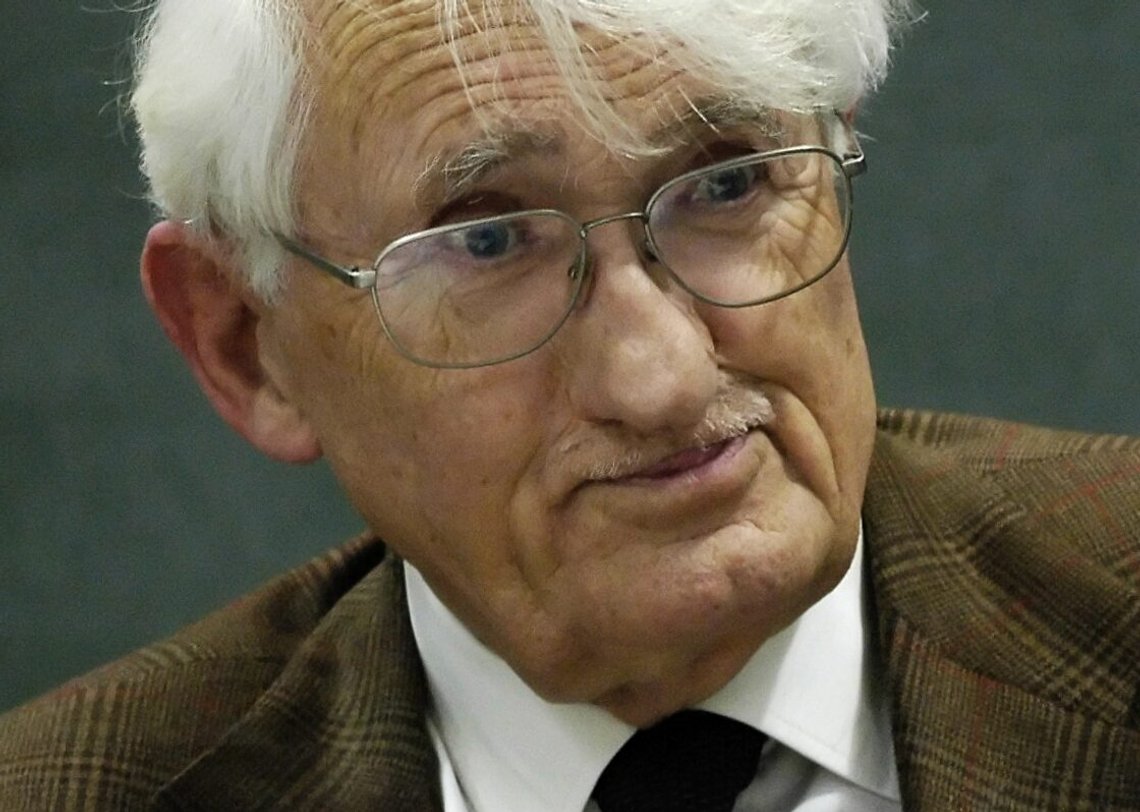


The German philosopher Jürgen Habermas died on Saturday at the age of 96. For more than sixty years, he was the West’s most indefatigable defender of the political project of reason. With remarkable intellectual steadfastness, Habermas survived the collapse of the world he had devoted his life to justifying.
It was a world in which political conflicts are resolved through arguments that can be justified to all, and in which citizens’ loyalty is directed towards principles rather than towards people and soil.
It was a left-liberal project that from the outset was doomed to fail, but which was sustained by the thousands of students and adherents that the gifted and highly productive philosopher gained at universities, in the media, and within the political system.
Habermas’ central concept was communicative rationality: the idea that legitimate political order arises only when it rests upon consensus achieved through open and power-free discourse. For him, the public sphere was not a struggle for power, but an unfolding of bourgeois reason. Democracy as procedure.
The constitution as an artificial fatherland
The philosophical project found its most concrete form in the concept of constitutional patriotism.
After Nazism, Germany was not to be united around people, culture, or historical continuity, for all of this had been compromised by barbarism. “Never again!”
Instead, political belonging was to be tied to the constitution, to human rights, to democratic procedures. The nation as a community of fate was to be replaced by the citizen as bearer of rights.
This was not merely a pragmatic solution to a German problem. For Habermas, it was a philosophical necessity. Any grounding of the political community in pre-political entities—blood, culture, religion—was a relapse into mythic thinking.
The post-national hope extended further: Europe, that is the EU, was to institutionalise reason, and the nation-state gradually be dismantled in favour of a cosmopolitan legal order. The world citizen was to replace the countryman.
Habermas was enamoured of the EU—the post-national constellation, as he called it—and of abstract procedures, although as an old thinker he grew wiser, as was expressed in his dialogue with Cardinal Joseph Ratzinger, the later Pope Benedict XVI.
The world would not be persuaded
What Habermas believed to have been overcome returned—not as atavism, but as a reality that refused to disappear.
Brexit was not a mistake committed by the unenlightened. It was a population insisting that belonging to a concrete people and a concrete place weighed more heavily than access to an internal market.
The migration crisis in 2015 did not divide the EU because procedures failed, but because behind the procedures there existed no common “we” capable of bearing the burden.
The war in Ukraine reminds everyone that great-power politics still concerns territory, power, and survival, not rational consensus.
Social media introduce disorder into the managed public sphere, and for that reason states and the EU are inclined to censor them.
The gradual erosion of the Schengen system is perhaps the most precise image: here the procedure encountered reality, and the procedure yielded.
The lost community
No one formulated the conservative opposition to Habermas with greater literary force than Botho Strauss and those around him in the so-called New Right. The accusation against Habermas’ generation was not political in the narrow sense. It was existential: a people that no longer dares to bind itself to its own traditions, its own myth, and its own historical continuity is not liberated. It is homeless.
Strauss and the New Right—thinkers such as Karlheinz Weißmann and Heimo Schwilk—turned constitutional patriotism on its head.
A constitution cannot bear the emotional and existential content that a political community requires. Rules and procedures do not create belonging. The cultural nation, by contrast—understood as a people that shares historical memory, language, religious heritage, and inherited customs—is the true foundation of political life.
It is not something one rationally adheres to. It is something by which one is formed.
Strauss’ essay “Anschwellender Bocksgesang” from 1993 provoked an outcry in German cultural life, illustrating Strauss’ point: that thoughts of belonging and tradition had been made taboo in the public sphere Habermas envisaged as free and open.
The parasite’s dilemma
The conservative fundamental accusation may be stated in concentrated form as follows: constitutional patriotism is parasitic.
It lives off the pre-political loyalty that it claims to have replaced. A constitution does not function in a cultural vacuum. It presupposes citizens who already share something—a willingness to abide by the rules of the game, a common sense of what justice requires, an attachment to the institutions that are to protect rights.
Abstract law is not self-sustaining.
One does not love humanity in abstracto. One loves one’s language, one’s city, one’s forefathers. And it is from this concrete relation of love that political virtue grows. Not from a procedure.
That critique strikes Habermas’ project at its core. When national and cultural identity is declared obsolete, the need for identity does not disappear. It finds new expressions, and often more explosive ones.
Respect without illusions
Habermas deserves respect. His philosophical diligence was genuine, his commitment unshakeable, and his personal decency beyond any doubt.
But the world would not be persuaded.
It is not governed by discourse, but by power, belonging, and history—that is, precisely those factors Habermas believed reason could overcome. His world did not disappear with his death. It disappeared during the years he lived on within its ruins.


