

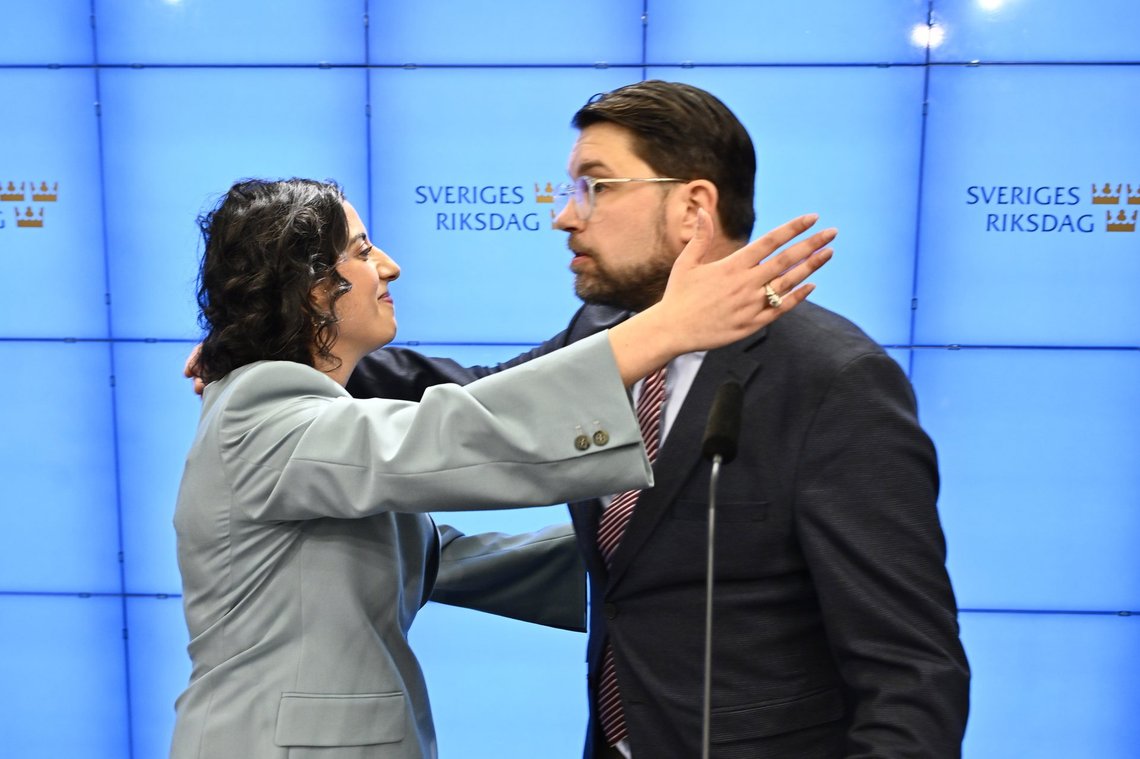
The backlash against Swedish Liberal leader Simona Mohamsson reveals a deeper problem on the left: an expectation that people with certain backgrounds must hold certain opinions—or be accused of betraying their identity.
When the leader of Sweden’s Liberal Party, Simona Mohamsson, signaled on Friday that she could accept the Sweden Democrats in a future government, she marked a clear political shift. Her statement broke with the party’s earlier position that it would never participate in a government that included the Sweden Democrats.
In politics, such changes are not unusual. Parties regularly reassess their positions as circumstances change.
What was striking, however, was not the policy shift itself—but the reaction.
The Reaction from the Left
Criticism from parts of the Swedish left was immediate and fierce. Yet some of that criticism revealed something deeper than ordinary political disagreement. It exposed a worldview shaped by identity politics, where individuals are expected to think according to their background.
In this framework, people with immigrant backgrounds are assumed to hold certain political views—typically those approved by the political left. When they deviate from that script, their independence is treated not as a legitimate choice but as a kind of betrayal.
The Strandhäll Comment
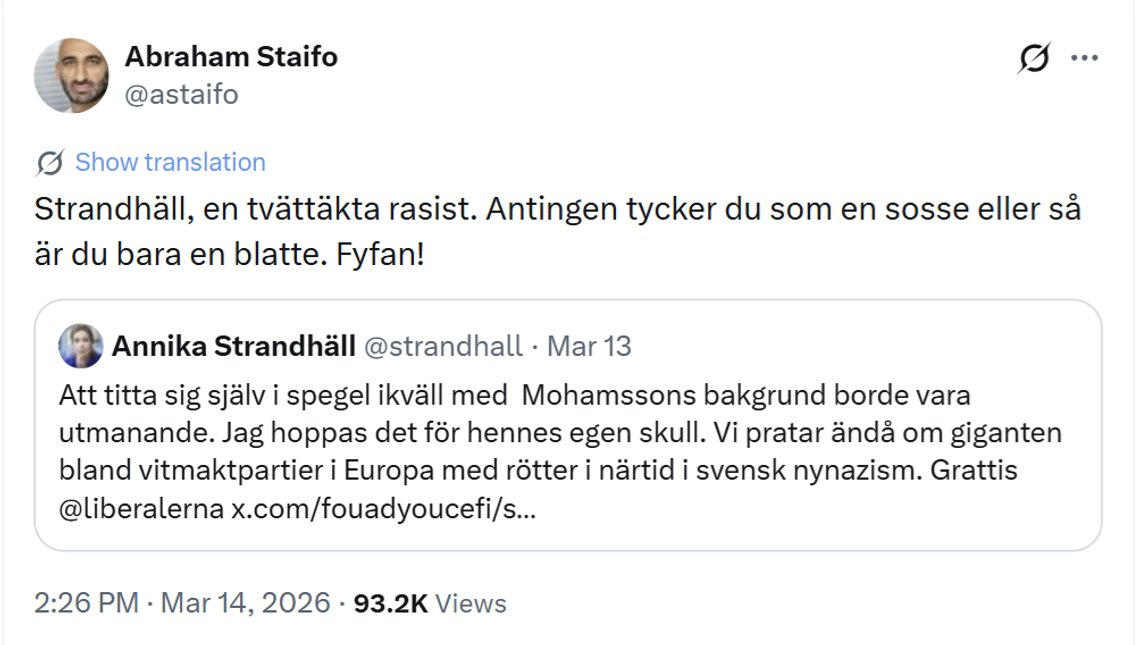
Former Social Democratic minister Annika Strandhäll perhaps expressed this most clearly when she wrote on X:
“Looking at yourself in the mirror tonight with Mohamsson’s background should be challenging.”
The remark quickly drew criticism—and for good reason. What exactly did Strandhäll mean?
Was she suggesting that a person with Palestinian and Lebanese family roots should not be able to accept cooperation with the Sweden Democrats? That people with certain ethnic or cultural backgrounds are expected to hold certain political views? That individuals with immigrant backgrounds should promote left-wing positions on issues such as migration, nationalism, and relations with Sweden Democrat leader Jimmie Åkesson?
If that is the case, the logic comes dangerously close to the very thing the left claims to oppose: the idea that individuals are not primarily individuals at all, but representatives of their ethnic or cultural group.
There is, after all, a well-known word for that idea.
It is racism.
A Blunt Response
The Liberal Party’s press chief in Gothenburg, Abraham Staifo, responded bluntly. According to him, Strandhäll’s comment revealed exactly this kind of thinking. In his words:
“Either you think like a Social Democrat, or you’re just a ‘blatte.’ Damn it.”
When the Individual Becomes the Problem
The controversy illustrates a deep paradox within modern identity politics.
For decades, Sweden’s red-green left has portrayed itself as the champion of anti-racism, standing firmly against anyone who reduces individuals to their skin color, ethnicity, or religion.
Yet when individuals with immigrant backgrounds fail to follow the expected political script, the reaction often reveals precisely the same logic.
The independent-minded immigrant suddenly becomes a problem.
Such individuals are accused—implicitly or explicitly—of having “betrayed their background.” The unwritten rule becomes clear:
If you have a certain background, you are expected to hold certain political views.
If you do not, something must be morally wrong.
It is difficult to describe that line of reasoning as anything other than deeply illiberal.
Revealing Reactions
Simona Mohamsson’s political position can, of course, be debated and criticized. That is the normal and healthy process of democratic politics.
But when criticism focuses on her background—suggesting that her origins should make her political stance morally suspect—it reveals far more about the critics than about Mohamsson herself.
In this worldview, people are not primarily individuals.
They are representatives of identities.
And those who step outside the expectations attached to that identity risk being labeled traitors, sellouts, or the modern equivalent of the old slur “Uncle Tom.”
A Genuinely Liberal Principle
Yet Mohamsson’s position highlights something important about the meaning of liberalism itself.
The truly liberal principle is simple: individuals should be judged by their ideas and actions—not by their ancestry.
That principle should apply even when someone reaches a political conclusion we dislike.
Mohamsson’s statement may say something about the future direction of Sweden’s Liberal Party. But the reactions from parts of the left say something even more revealing.
They show how quickly lofty rhetoric about individual freedom can give way to the old reflex of identity politics: placing people into categories—and expecting them to stay there.
When someone refuses, outrage follows.


