Work on next year’s state budget (statsbudsjett) is under way. Finance Minister Jens Stoltenberg signals a tighter budget, yet grants total protection to the sickness benefit scheme (sykelønnsordningen) and disability benefit (uføretrygd), even though 700,000 people of working age are outside the labour market on these schemes. At the same time, the government pours money into health care without measurable health gains.
Another budget item that invariably swells when the Labour Party (Arbeiderpartiet) is in government is the aid budget (bistandsbudsjettet). In the period 1960–2026, Norway has spent a nominal total of NOK 996 billion on aid. But if one adjusts for inflation to 2025 kroner, the amount comes to NOK 1,509 billion, which corresponds to NOK 268,000 per inhabitant.
If we in addition include the alternative return on the money, the amount is substantially higher. With an annual return of 5 per cent, the total amount would have been NOK 4,837 billion, corresponding to NOK 860,000 per inhabitant. Instead, however, the Labour Party has chosen a policy that causes the state to expand, while households are the most heavily indebted in the world.
There are no concrete results available that can tell us whether this aid has produced any results. The only thing we know with certainty regarding aid is how much money has been spent. In the current year NOK 56.6 billion is to be spent on aid. That is roughly NOK 10,000 per inhabitant.
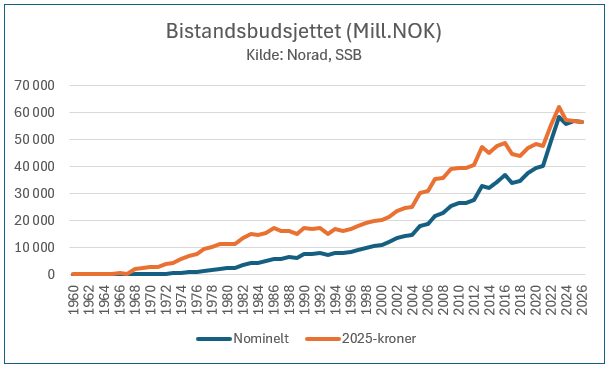
Norwegian aid, nominal and inflation-adjusted, 1960–2026. Source: Norad/SSB.
It is a well-known fact that what one scatters around loses value. The same applies to money.
When the state spends large sums without achieving results—more money for schools without pupils becoming measurably more capable, more money for health care without measurable health gains, or more money for aid without achieving anything other than a need for even more aid—one ends up with ever more money in circulation without value creation. The value of money then deteriorates, prices rise, and interest rates must be increased in an attempt to restrain price growth. That is the situation Norway finds itself in today under current policies.
Another thing that becomes apparent the more one digs into the aid budget is how many hundreds of so-called non-governmental organisations, with thousands of employees in Norway and abroad, are on the receiving end.
We know of Terje Rød-Larsen’s IPI, which received NOK 128 million. And we know of the World Economic Forum, which has received NOK 124 million, where Børge Brende, as foreign minister, “bought” himself a job with an annual salary approaching NOK 20 million by channelling tens of millions of aid kroner to the organisation, an arrangement reminiscent of a kickback at the expense of taxpayers.
But IPI and WEF are dwarfed compared with LO, which received NOK 715 million in the period 1999–2025. Or the Labour Party (Ap), the Labour Youth League (AUF) and Arbeidernes Opplysningsforbund directly, which together have received NOK 23 million. Not to forget the Latin America Groups (Latin-Amerika-gruppene), which have received more than NOK 100 million through the aid budget and which are used for study trips and not least socialist propaganda activities in Norway. The association Fri has received NOK 220 million. The Norwegian Union of Journalists (Norsk Journalistlag) has received NOK 140 million—and so on, and so on.
The list is long, and what emerges from our investigative work is a web of left-leaning political activism, grants and mutual dependency. The question is whether Jens Stoltenberg has the stomach to cut this before he departs for the job waiting for him at the hedge fund EQT.