

Since the mid-2010s, Norway has taken the initiative for a role in international negotiations with Iran. This is in line with the Norwegian policy of engagement of which the Oslo Accords were a part. From 2010, aid to Iran increased. The investigation into the assassination attempt against William Nygaard lay in mothballs while the Islamic Republic was enabled to free up funds for terror, thanks to Norwegian aid funds.
One of the most important objectives of Norwegian foreign policy since the Cold War has been Norway’s role as a proactive peace nation on all the continents of the globe. This has provided international career opportunities for Norwegian political scientists and sociologists on a scale the world has never seen before, financed by steadily increasing oil revenues. Historian Terje Tvedt describes the emergence, and not least the acceleration, of this system in the book “Det internasjonale gjennombruddet”, where he refers to the system as “the humanitarian-political complex”.
Norwegian aid plays a central role with a budget in the current year of just under NOK 57 billion.
In the article “Norske bistandsmillioner til islamistisk skrekk-regime” we wrote: “Since the third Brundtland Government resumed aid in 1992, Norway up to and including 2024 has given NOK 671 million in aid to Iran. In this way the Islamic Republic has been able to free up funds that it has been able to use for other purposes, such as financing terrorist organisations such as Hamas and Hizbollah as well as criminal groups operating in the West, including Norway. And not least to suppress its own population, of whom it has killed and tortured an estimated 50,000 so far this year.”
Norway as a back channel for Iran
In 2016 Norway initiated a dialogue with the Islamic Republic of Iran concerning the situation in Afghanistan. This was motivated by migration, regional stability, and the role of the Taliban. Norway’s role in this consisted of the initiative for dialogue meetings.
In addition, Norway functioned as an informal back channel and messenger between Iran and the United States in periods when direct contact was lacking, particularly after the United States’ withdrawal from the nuclear agreement in 2018, during President Trump’s first term, an agreement that had been concluded under President Obama and which released large financial resources for Iran which it has turned out that Iran has used for military rearmament.
This provided many exciting travel and international seminar opportunities for employees in the Ministry of Foreign Affairs (UD) and various non-governmental organisations. This was entirely in line with the culture that super-diplomats such as Terje Rød-Larsen, Mona Juul and Geir O. Pedersen had spearheaded in the Royal Ministry of Foreign Affairs.
However, the Ministry of Foreign Affairs will not answer questions about back-channel activity, as in this case, where a retired Pedersen and NOREF chief Johan Vibe and President Abbas’s senior adviser Majdi Khaldi met in secret at the Grand Hotel on 12 February.
The flow of money resumed
After some years around the financial crisis, with meagre aid to Iran, it was kick-started again in 2010 with as much as NOK 44 million. Thereafter the annual aid from Norway to Iran has been close to NOK 18 million on average.
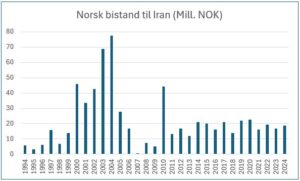 Aid to Iran 1994–2024. Source: Norad
The aid has for the most part gone via the Norwegian Refugee Council (Flyktninghjelpen), which is led by Terje Rød-Larsen’s former collaborator in the Oslo process, Jan Egeland (Labour Party, Ap). According to Norad, the funds go to assist Iran with refugees from Afghanistan. These are, however, refugees Iran has received ever since the war against the Soviet Union in the 1980s.
The refugees Iran has received fulfil the following criteria: They are Shia Muslims, they speak Persian, and they have the same cultural background as Iranians. Ergo the oil country the Islamic Republic of Iran practises a refugee policy that is the exact opposite of the Norwegian one. While the Iranian one focuses on monoculture, the Norwegian one focuses on multiculturalism. But that does not prevent Norway from financing it.
As money can be used for many things, the flow of money from Norway has relieved the Islamic Republic in refugee policy, so that funds have been able to be freed up for other purposes, such as military rearmament and the equipping of terrorist groups such as Hamas, Hizbollah and the Houthi militia, all of which are financed by Iran.
Prestige most important?
After the release of several Epstein files at the beginning of February, Norwegian foreign policy has come into a questionable light. An enormous need for prestige in the foreign-policy processes has become apparent, where the Oslo process and the story of Terje Rød-Larsen’s private basement storage archive have set an entirely new standard with regard to lack of credibility on the part of the authorities.
Prime Minister and former Minister of Foreign Affairs Jonas Gahr Støre has rejected the existence of the archive on up to three occasions, which he today denies. At the same time, the current Minister of Foreign Affairs Espen Barth Eide is attempting to row home an explanation that the whole matter has depended on linguistic misunderstandings. A secrecy and need for prestige is being revealed in all its embarrassment.
Can this culture and personal desires for star status within international diplomacy have caused Norwegian foreign-policy politicians and diplomats indirectly to have made themselves guilty of financing terror, and of a lack of progress in the investigation of the assassination attempt against William Nygaard in 1993, where the traces point towards Iran, simply by closing eyes and ears to what Iran’s freed-up funds as a consequence of the Norwegian flow of money are used for?
Can the consideration of what role Norway shall have as a peace nation have weighed heaviest and thereby indirectly financed terror and functioned as sand in the machinery for a final clarification of the assassination attempt against Nygaard?
No answer from the respective authorities is forthcoming. At best one is requested by an information consultant of whom there are thirteen to the dozen in directorates and ministries to send an e-mail that is never answered. But the question should nevertheless remain hanging until an answer is provided.


