

Document wrote that LO has received over NOK 700 million through the aid budget. The figure has now been confirmed at NOK 715 million. But that was only since 1999, according to figures from Norad. It now emerges that the flow of funds to LO began 20 years earlier, in 1979. It may concern an additional half a billion kroner.
7 March Document wrote that LO has received over NOK 700 million through the aid budget.
LO har mottatt over 700 millioner kroner over bistandsbudsjettet
This was based on a search in Norad’s database “Bistand i tall”. There it appeared that LO had received NOK 691 million in the period 1999–2024. In 2024 they received over NOK 27 million through a framework agreement. With the assumption of a corresponding amount for 2025, Document concluded that LO had received over NOK 700 million.
Document has received a response from LO. In 2025 they received NOK 24 million. This means that LO in the period 1999–2024 has received NOK 715 million through the aid budget. But it now turns out that this amount may be substantially higher, estimated at half a billion kroner more.
Since 1979
In the previous article we presented a number of questions that we had sent to LO by e-mail. In what follows we reproduce the questions and answers in the same order. The questions appear in italic type. The answers from LO and Liv Tørres are given in quotation marks.
1. According to Norad’s statistics this flow of funds began in 1999. Comment and specify if necessary.
“We received some support from Norad for our work already from 1979; thereafter this at some point became multi-year framework agreements. Norad is the best source for an overview of allocations from them.”
Norad’s database only shows figures back to 1999, Document replied.
“We must dig somewhat in the archives to find figures from 1979 to 99. We will give you feedback when we have these, but I believe these were smaller amounts. As you may understand, this was long before my time in LO, so I do not know this offhand. We will return to you on this,” writes Liv Tørres in an e-mail.
If LO in the period 1979–1999 received anything close to what they annually have received after 1999, this means that LO may have received more than an additional half a billion kroner, which would bring the total to over NOK 1.2 billion through the aid budget.
2. What was the basis for LO receiving money through the aid budget?
“To support the building up of free and independent trade union movements that contribute to creating more equitable distribution, reducing poverty, function as watchdogs vis-à-vis governments and contribute to creating democracy. The trade union movement also negotiates with the authorities to increase minimum wages and strengthen workers’ rights, etc.”
How LO chooses to manage the membership dues from its members is a matter for LO and its members. A point of debate is whether LO’s spending financed by aid funds is a societal task imposed on taxpayers.
3. What can LO contribute to the aid field that existing aid organisations could not handle?
“There are no other existing aid organisations that work with organisational development, i.e. strengthening the trade union movement so that it can organise more members, ensure better representation of women in the trade union movement and working life, and strengthen the trade union movement in negotiations and collective agreements vis-à-vis the employers’ side.”
4. How much did LO receive in 2025?
“The budget for the framework agreement is NOK 24 million in 2025. Unused funds from 2024 come in addition. How much of these funds has actually been used we will not know with certainty until the audit has been completed.”
5. What is the budget for this year?
“The framework agreement with Norad has a budget of NOK 24 million in 2026.”
I understand that this is anchored in a long-standing framework agreement and that the funds go to organisational development in a number of countries. Under the present government 2021–2024:
Table of the 20 largest recipient countries of aid funds under LO’s auspices:
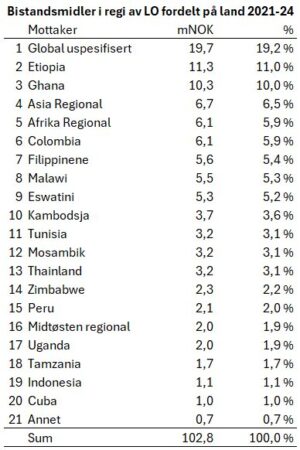 Top 20 countries receiving aid via LO in 2021–2024. Source: Norad
“I assume you have this from Norad (and our annual reports), so I will not spend time here quality-assuring this,” Tørres replies.
Administered by local trade unions
6. Who are the recipients in these countries?
“The trade union movement (the national confederations) in the respective countries.”
7. Who determines the distribution? Please provide names if possible.
“LO in cooperation with the national confederations in the countries concerned.”
8. Who directs the aid in the respective countries?
“It is primarily the national confederations in the respective countries that direct it, in the sense that they set their own priorities.”
9. How does the distribution of funds take place?
Are these expenses for LO personnel from Norway who travel to the countries concerned and conduct information work?
Is it salaries for local instructors?
Who and where formulate the message and expertise that are transferred to these countries?
“It is first and foremost the national confederations in the countries concerned that specify their needs. LO also has an international strategy which we apply as the basis for our work internationally. Our contributions are concentrated on enabling the trade union movements abroad to organise more members, strengthen themselves in collective bargaining, and increase the number of women in the trade union movement.”
“Very little of these funds are used for LO personnel travelling out to conduct information work, as you describe it. The funds primarily go to the international trade union movements’ own work. The message and expertise on which they and we rely have been shaped and documented by the international trade union movement over many decades: namely that membership numbers and strength at the negotiating table with employers will provide wage growth for poor workers, more equitable distribution and more democracy.”
10. What concrete results have been achieved with this aid?
“We have documented good results over a number of years with more women in the trade union movement and in trade union leadership; more collective agreements; more members in a number of trade union movements, etc. The results are reported annually to Norad and after each agreement period. We score well in the Norad context on results. Several of our final results have also been presented as good results in the governments’ state budgets.”
Denies hidden party support
The description of Document’s interest in this topic was presented as follows: The journalistic coverage of the aid field has, to put it mildly and without exaggeration, been almost absent, given the scale of the total amounts and the number of bodies that receive funds for further administration. Our perception is that the public has almost zero awareness of this field, even though they pay the bill.
That LO receives funds is particularly delicate, since LO also transfers roughly corresponding amounts to the Labour Party as it receives in aid.
This in turn means that taxpayers, unknowingly, implicitly provide a disproportionately large financial contribution to the Labour Party compared with what other parties receive. BECAUSE, without the funds from the aid budget, LO would have had to prioritise financial support to the Labour Party against spending on aid work.
To this LO replies:
“There is a conflation in your presentation that we cannot recognise. LO’s party support in Norway and our international work are two completely separate matters, both organisationally and financially. It has never been relevant for LO to ‘choose’ between support for political parties here at home and our international solidarity work.”
Document’s point is that without the aid funds LO would have had to choose. As long as the aid funds are there, this is an unknown problem for LO.
“LO’s international work has been ongoing for many decades and is a fixed and independent part of our societal mission. We also have a separate LO fund that we use to support the international trade union movement. We use our own funds to finance staff who work with international trade union solidarity and to cover our co-financing share of the framework agreement with Norad.
Norad funds are transferred as support to the international trade union movement. To present this as indirect or hidden party support for the Labour Party therefore gives a very inaccurate picture of both the financing and the purpose of LO’s international work.”
Uncertain about Norad’s categorisation
11. Norad writes that the funds have gone to the health and social sector. How does that harmonise with your statement that the funds go to organisational development?
12. Is it a question of LO conducting organisational development within the health and social sector in countries such as Ethiopia, Ghana, Colombia, Eswatini etc.?
“A little uncertain where Norad has categorised us under ‘health and social’. We fall under ‘civil society’ and in practice support organisation, negotiations and equality work within the trade union movement in several sectors.”


