




Wars are, to put it in the words of General David Petraeus, above all “perception wars”.
The former head of research in Israeli military intelligence, Itai Brun, explains Iran’s “theory of victory” in an interview with The Free Press: “The regime has endured and will survive.” It does not matter how many ships, aircraft, nuclear bunkers, missile launchers, ayatollahs, pasdaran (Pasdaran), or palaces the enemy may destroy: if the war ends with a perception that the West has failed to annihilate us, we can declare victory.
This applies especially if the West, with the exception of only two countries, is chiefly concerned with lamenting that international law lies in ruins (Chancellor Merz is right: “International law protects Iran”) and discussing the threat to stability in the region and the increased price of hydrocarbons. It applies all the more if we even have prime ministers who tell Trump that he must enter into dialogue, while party colleagues of theirs are arrested for espionage for China, if there are parties that support Iran, if flags with the Star of David are burned in our squares, and if the police arrest Iranians who spy on Jewish communities with the aim of carrying out assassinations.
All this constitutes inalienable privileges of Western democracy.
But it is a flaccid democracy, governed by politicians in silk underpants who tremble at the thought of getting their hands dirty. The real luxury is always the same: to be able to permit oneself to hate Netanyahu and Trump as if they were the devil, while at the same time closing one eye – or rather both eyes – to a regime that executes innocents in construction cranes, that stones and massacres children who dare to cry “freedom”, enriches uranium to 60 per cent, and manufactures missiles capable of reaching the white cliffs of Dover.
In Stalin’s time the reflexes of the “fellow travellers” were the same. Not everyone can be a Victor Serge, an André Gide, an Arthur Koestler or an Ignazio Silone.
Our flaccid leaders use strong words when they condemn Western attacks, but their voice becomes soft when it comes to condemning the regime of murderers. They are masters of a perfected balancing act: to condemn emphatically what comes from Tel Aviv or Washington, and to envelop Tehran in the reassuring fog of “dialogue” and “de-escalation”.
Michel Onfray is right with regard to Iran: we are witnessing Huntington’s clash of civilisations, and a part of our own stands on the side of the others.
It truly requires a certain talent to proclaim oneself the defender of the people while at the same time appeasing those who oppress it. It requires solid mental discipline to hate Western leaders rather than support an Iranian people who risk prison, torture and death for a slogan, and who long to free themselves from their tyrants, if necessary with bombs.
Iranians cannot afford such a luxury. They have Evin Prison, the gallows erected at dawn and the funerals that take place at night. No one can readily blame them for thanking “Bibi” and “Abu Ivanka”.
In his book from the year 2000, “The America We Deserve”, Trump was rightly concerned about the risk that Iran’s proxies could soon operate under the nuclear umbrella of their sponsor:
“You can be assured that right now there are fanatics, whether they sit in the councils of doomsday cults or in the cabinets of rogue states, who are plotting and waiting for their moment to strike. The question then is: What can we do to best protect our cities? A lot more than you might think.”
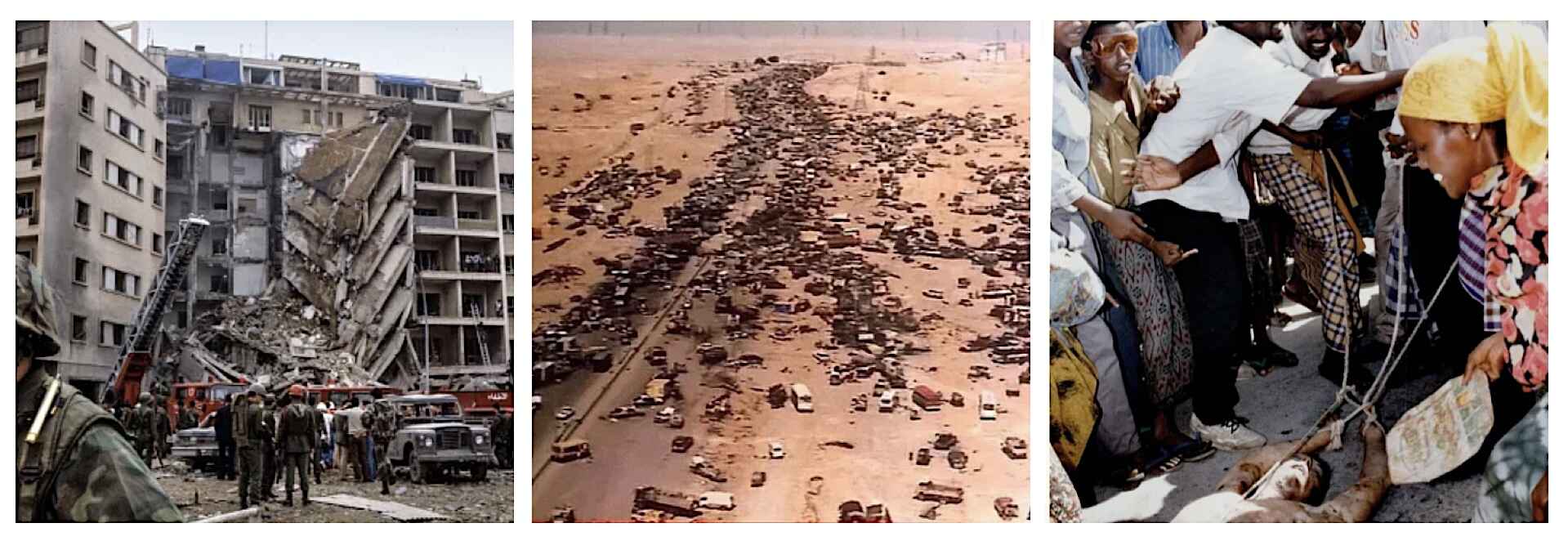 Beirut, Iraq and Somalia
In 1983 armed terrorists supported by Iran detonated truck bombs in Beirut that killed 220 American soldiers and 21 other military personnel. The United States did nothing.
In 1991 Western public opinion was shocked by the image of the “Highway of Death”, with Saddam Hussein’s army of criminals bombed while fleeing from Kuwait, and it triggered demands for the immediate cessation of hostilities in Iraq and Kuwait. The result was that the air defences and the divisions of Saddam Hussein’s Republican Guard were spared. And during the subsequent “peace” it was those troops that massacred Kurds and Shiite Muslims. In 1993 the image of a dead American soldier dragged through the streets of Mogadishu after the “Black Hawk Down” incident led Bill Clinton to order a shameful withdrawal from Somalia.
A downed helicopter and a corpse dragged through the streets in its underpants – and Clinton fled Somalia like a thief caught in the act. From then on Americans thought: it is better not to intervene and not to get one’s hands dirty, and better to allow the chaos created by others to simmer.
Robert Kagan coined the phrase: “Americans are from Mars, Europeans are from Venus.” And from time to time Americans remember where they come from.
“Well, gentlemen, when the shit hits the fan some guys run and some guys stay,” says Al Pacino in “Scent of a Woman”. In a shower of shit many run away and few remain.
Americans and Israelis are like us. They also wish to winter in warmth, enjoy their holidays and retire as soon as possible. The difference is that when the shit hits the fan, the United States and Israel are the only ones who remain and resist.
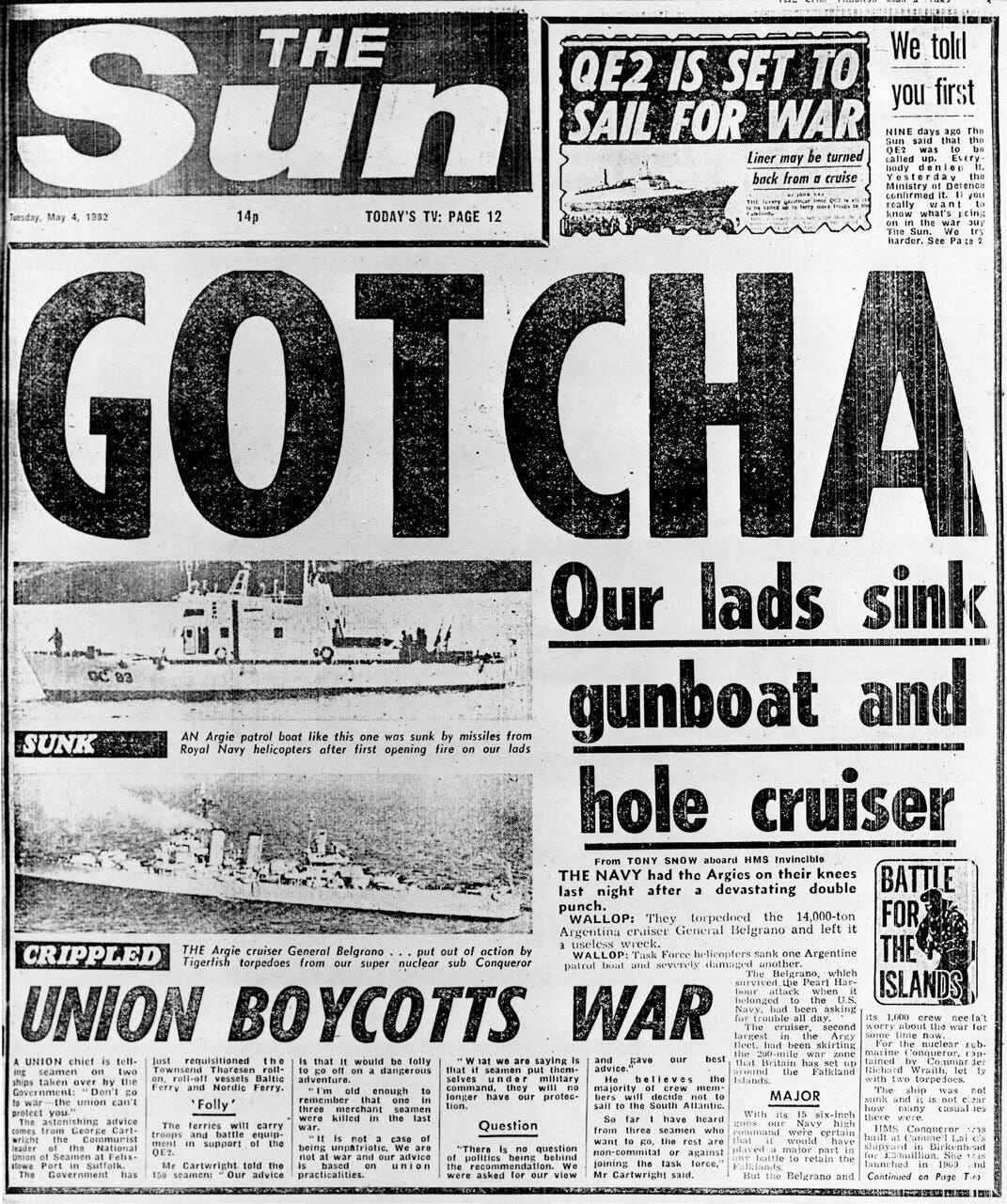
When HMS “Conqueror” sank ARA “General Belgrano” during the Falklands War in 1982, and Argentina lost 323 naval personnel, “GOTCHA” appeared in large letters on the front page of The Sun. That headline would not be published today.
When the Americans in 2014 were occupied with bombing IS in Iraq and Syria, what did Europe do? They invoked “international law” to justify refusing.
We are always in the forefront of the struggle for Olympic gold in cowardice. When it was time to bomb IS, we called the United Nations, as a child calls its mother.
Yohan Gross, a 30-year-old professor of mathematics at the Hebrew University of Jerusalem, recently told The Telegraph: “As Israelis we feel that we are doing the dirty work that Europe does not want to do. The British and European governments prefer to wait and see, to be diplomatic and to do everything in a diplomatic way. But that does not work every time, and especially not with Islamists. We do the dirty work because we stand on the front line and have no choice. It is absurd that we are criticised for this, particularly because Europe can enjoy the fruits of everything we do here.”
In 2004 al-Qaeda succeeded for the first time in carrying out a regime change in Europe after committing the terrible terrorist bombings of trains in Madrid. Immediately after these attacks the election in Spain was transformed into a referendum on the country’s participation in the Iraq war. The astonishing and unexpected victory of the Socialist Party was followed by the withdrawal of Spanish forces from Iraq.
After the massacres in Atocha Spain transformed grief into an anti-American referendum, and the country fled Iraq with its tail between its legs. Since then the country has been absent from the map of serious geopolitics.
Barcelona municipality has just issued new guidelines for Ramadan for the city’s schools. They recommend that schools support Muslim pupils by avoiding music and dancing during the Islamic month. Do you see the picture?
German media were shocked by the revelation that the German air force would be attacked during a potential operation against IS in Syria. “German soldiers put in danger!”, wrote Bild, Germany’s best-selling newspaper – with exclamation marks. The wording illustrated concern about what John Vinocur in the Wall Street Journal has called a “country where the army and the air force essentially do not engage in combat”.
“Diplomats in uniform,” Angela Merkel’s soldiers were called. Germany had aircraft that could not be used at night, and the chancellor had planned a further reduction in defence investment, in favour of the massive plan to receive migrants.
When Obama asked Merkel to do something against IS, Merkel replied nein.
The spokesman for the Belgian defence minister, Andre Flahaut, suggested that it was above all an ideological problem: “I am not sure that the task of the military is to engage in combat.”
Italy too, like Spain, evaded its responsibility in the war against IS. Italy’s defence minister Roberta Pinotti rejected the idea of Italian participation in the action against IS.
Of all French soldiers engaged in military operations, half are deployed in France. And half of those protect 717 Jewish schools.
The skilled Lee Smith writes in Tablet about the ongoing war:
“It is difficult to win and easy to lose. Now, after having embraced the ethic of defeat and elevated it to a sign of personal virtue, those who demoralise stand clearly on the side of the loser – for the ayatollahs and against the White House’s and the Pentagon’s demonstration of military dominance in Iran’s airspace. The lesson is that losers enjoy one another’s company, even if the company wears priestly robes stained with the blood of thousands of Americans and hundreds of thousands of innocents throughout the Middle East. As the history of the American far left shows, there is no way out of that kind of bitterness, partly because it is where history’s most determined losers feel most at home. The rest of us prefer to win.”
For us Europeans it has now become almost natural to lose.
It is always about choosing between victory and self-inflicted defeat.
Because of the war against Tehran thousands of European citizens are stranded in the Middle East. In addition to all the heart-rending videos from our friends and influencers in Dubai and Abu Dhabi, the news channels broadcast touching reports about this new category of victims: tourists stranded in a conflict zone, outraged at having been “abandoned”. And when they finally arrive in Rome and Paris, microphones are directed at them to capture their suffering.
We are witnessing an anthropological collision. On the one hand tourism in this borderless world sees nothing but destinations to visit, exotic tribes to discover and mega shopping centres to explore. On the other hand we have the old and tragic reality of war: us or them, or to put it in the words of Italy’s chief of defence Carmine Masiello: “We do not want war, but when it comes it does not ask permission.” Tourists discover that history is not an attraction one can step off like a carousel. They naturally turn to the state as if it were a tour operator.
They discover with delayed horror that the world is not an Airbnb catalogue and that history does not pause to give us time to check out. They demand immediate repatriation, transport and psychological compensation. Peter Sloterdijk has understood it: “Post-heroic Europe says yes to taxes and demands zero sacrifices.”
We pay the ticket, but woe to whoever asks us to risk our lives.
If our forefathers had been like us, I am frankly not sure that Western civilisation would have survived.
The great Philippe Muray already said it all in “Chers djihadistes” (read it): Bastards, you have interrupted our aperitif, our Netflix series and our long weekend. Do you wish to fight a civilisation? Too bad, because it no longer exists. There remains only a terminal West, devoted to consumption in bathing sandals and pirated sunglasses, sipping a mojito while history slams the door in its face.
As he writes: “Let us say it plainly: You have disturbed us. You surely understand that this has not been welcome, and that we wish to resume our daily routine as soon as possible.” The Islamists believe they are putting an entire civilisation in check with “its deeply secularising, desacralising, seductive, obscene and commercial tendencies. Sorry, but it is not quite like that. You are aiming at the wrong windmill. There is no civilisation here.”
In this landscape of kneeling molluscs there are nevertheless two who do not give up: the Americans, who from time to time remember that they come from Mars, and the Israelis, who have no choice, because Jerusalem is their home, the front line – and if they give up they end up at the slaughterhouse.
And we? We continue to complain about the price of petrol, post stories from Santorini and debate in parliament what antisemitism is.
Meanwhile, as Muray wrote, “the West dies in Bermuda shorts”. And it can only hope that the wind does not change too quickly. For when the shit hits the fan, it is not enough to open the window.


