

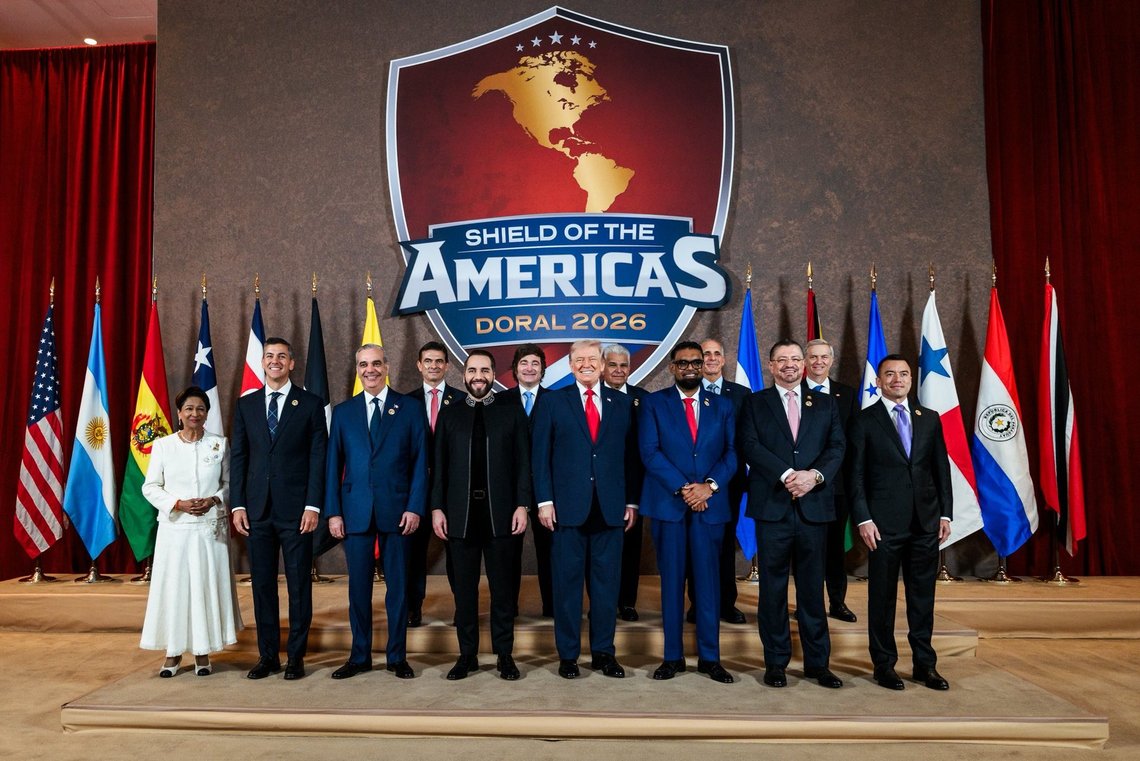
In just a few months, Donald Trump has left a clear mark on international politics. From the Middle East to Latin America, the United States is signaling a new course in which security, power politics, and regional alliances once again take center stage. This weekend, the U.S. president used that momentum to host a summit with several leaders from Latin America.
The initiative, called “Shield of the Americas,” was announced during a summit at the Trump National Doral resort outside Miami. The meeting launched a new security alliance for the Western Hemisphere—with drug cartels, Venezuela, Cuba, and Chinese influence identified as the main challenges. The alliance is intended to strengthen military cooperation and intelligence sharing among participating countries in order to combat transnational criminal organizations across the Americas.
From the stage at Trump National Doral, Trump made it clear that the era of half-measures is over:
“We come together to announce a brand new military coalition to eradicate the criminal cartels plaguing our region,” the president said.
The Cartel Fight
Trump called the cooperation the Americas Counter Cartel Coalition and made it clear that this is primarily a geopolitical power project, not just another regional talking shop. He went even further when describing the substance of the agreement:
“The heart of our agreement is a commitment to using lethal military force to destroy the sinister cartels and terrorist networks once and for all.”
With that statement, he effectively elevated the fight against cartels from routine law enforcement to the level of a regional security doctrine.
The summit brought together leaders such as Argentina’s Javier Milei, El Salvador’s Nayib Bukele, and Ecuador’s Daniel Noboa—politicians who, to varying degrees, advocate a hard line against crime and closer cooperation with Washington. At the same time, the absence of Brazil, Mexico, and Colombia was striking. The meeting therefore appeared less like a pan-American summit and more like a bloc of politically aligned governments.
The summit also marked the debut of Kristi Noem in the role of U.S. special envoy for the initiative. The position was created to coordinate cooperation between the United States and the Latin American partner countries in the coalition. Noem will work under Secretary of State Marco Rubio and help develop security cooperation and operational coordination in the region.
Cuba Nearing Its Final Act
Trump also linked the initiative directly to developments in Venezuela and Cuba. In his speech, he portrayed the operation against Nicolás Maduro as proof that the United States is willing to act—not merely issue warnings. About Cuba, he said the country is “in its last moments of life the way it is,” and predicted that “great change” is coming.
Such statements are not interpreted in the region as empty rhetoric. They are widely seen as a signal that Washington intends once again to shape developments in its own hemisphere.
At the same time, the initiative is about more than cartels and regimes. China looms in the background of the entire project. The United States has increasingly expressed concern about China’s growing economic and strategic presence in Latin America, particularly through investments in infrastructure, ports, and natural resources. During his speech on Saturday, Trump made clear that the United States will not accept “hostile foreign influence” in the hemisphere.
The EU Wants In
But the United States is not alone in seeking stronger ties with the region.
Ursula von der Leyen and the European Union have intensified efforts to establish closer trade agreements with South American countries, particularly around the Mercosur framework. Europe is seeking access to markets, food supplies, minerals, and strategic raw materials.
This means Latin America is no longer simply America’s backyard—it is increasingly becoming an arena of rivalry between Washington, Beijing, and Brussels. The difference is that the EU arrives with trade agreements and regulatory frameworks. Trump arrives with a security bloc and military power.
The summit in Miami may therefore mark the beginning of a new approach: less multilateral diplomacy, more geopolitical realism. Trump does not merely intend to manage developments in the region. He intends to dominate them. With Shield of the Americas, President Trump may be sketching the outline of a new global order—right before our eyes.


