

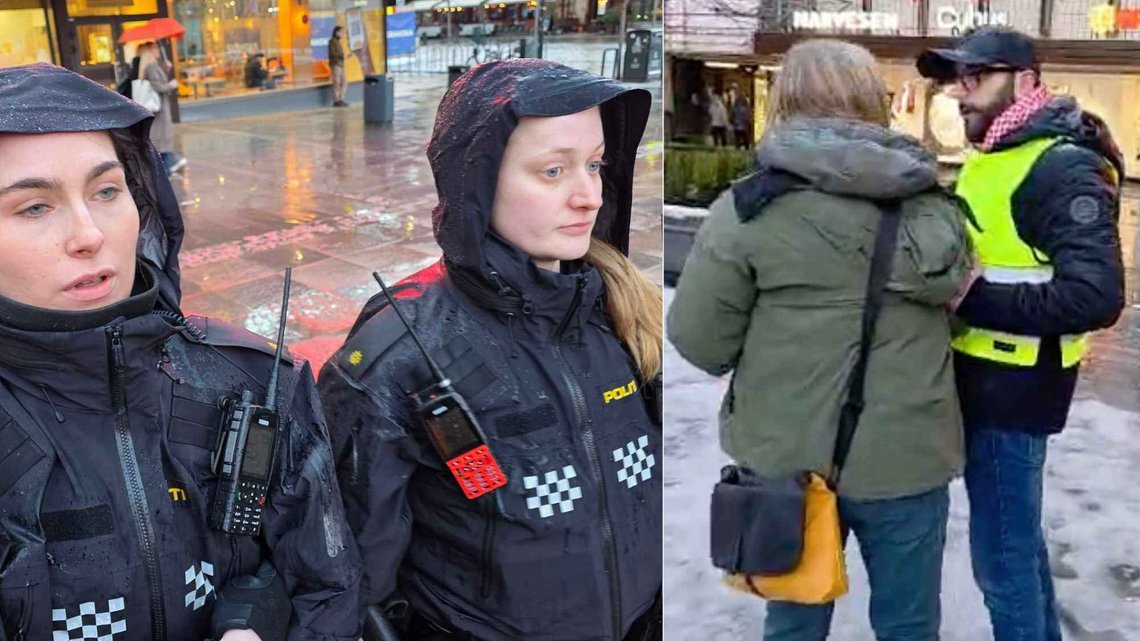
Despite presenting her press card, two female police officers complied with the Iran demonstrators’ demand: have Document’s journalist removed from the location.
Document’s journalist Bente Haarstad was yesterday prevented by activists and by the police from taking photographs of a public gathering at Torget in Trondheim. Among the organisers were LO, AUF, SV, Rødt, NKP, Norwegian People’s Aid (Norsk Folkehjelp) and the Palestine Committee (Palestinakomiteen).
Several of the participants held up the flag of the Iranian regime and pictures of the slain Iranian dictator Ali Khamenei.
A press card was not good enough for the police.
The two young policewomen threatened Haarstad with removal if she did not comply with the order to leave the location herself.
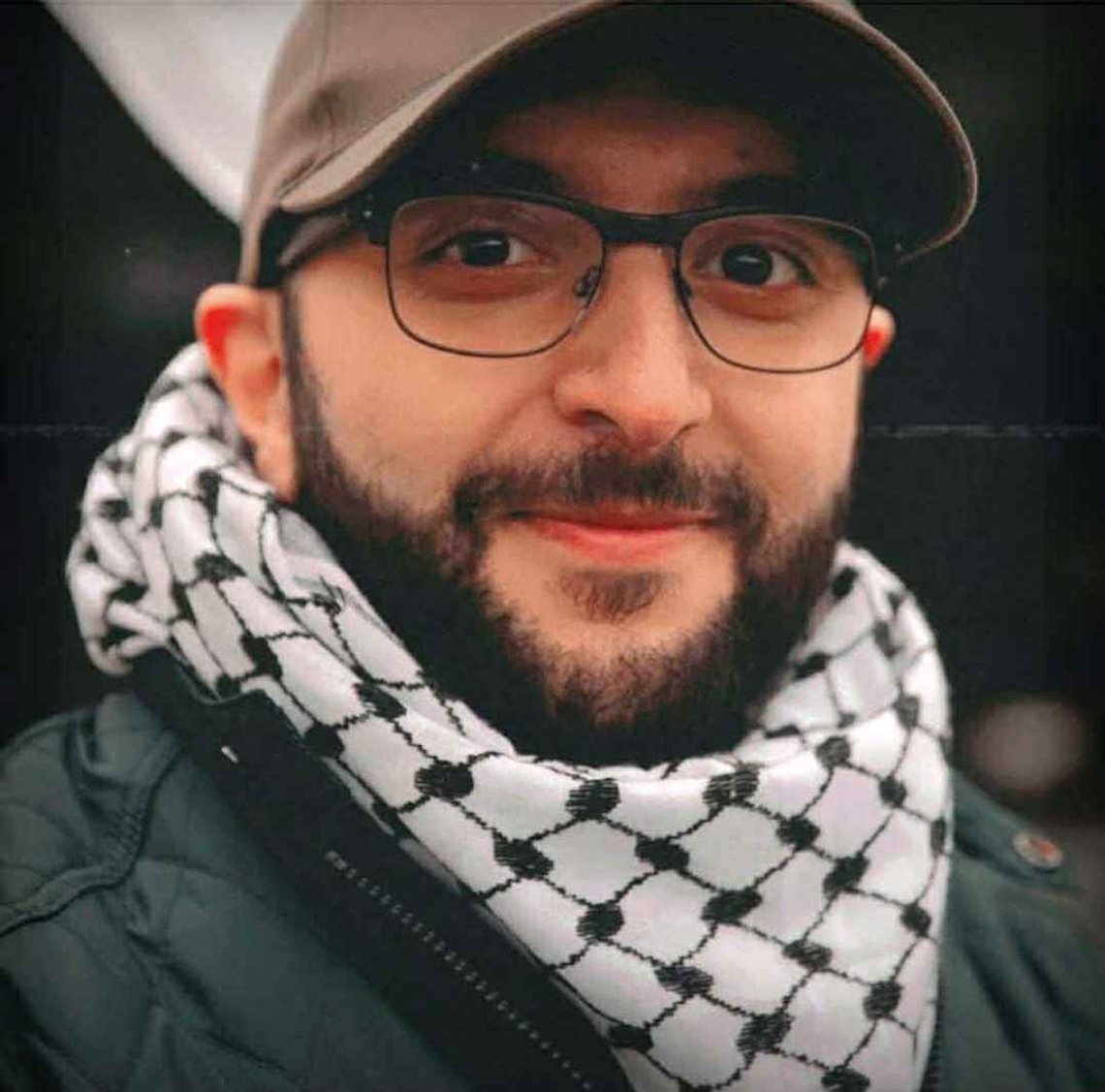 Zuhair Swaid of the Palestinakomiteen seized Document’s journalist and led her away from the demonstrators and over to two police officers. He repeatedly promises to sue anyone who photographs him in a public place. (Photo: Private)
Video recordings show that two foreign Palestine activists alternately push and escort Haarstad away from the demonstration while threatening to sue anyone who takes photographs or films.
One of them also claims in one of the recordings to which Document has obtained access that he has full authority to expel persons from the public space. The most active in preventing the press was Zuhair Swaid from the Palestinakomiteen. It was he who spoke with the police.
He succeeded in having his demand that Haarstad be removed from the location granted.
He achieved this by persuading them that Haarstad “is a racist” and therefore could not be allowed to cover the demonstration.
The other activist who accompanied them to the police is Bassam Hussein, an NTNU professor from Gaza, whom Document has mentioned several times previously. Among other things, he has publicly praised the deceased Hamas leader and the mastermind behind the 7 October pogrom, Yahya Sinwar.
Photo-blocked by Islam convert
Bassam and Zuhair took action after Haarstad had first been prevented from taking photographs by a Norwegian convert to Islam who blocked her camera.
When they arrived at the police patrol, Haarstad produced her press card.
– I said that I was being prevented from performing my work. They told me to withdraw, otherwise I would be removed. The police actually claimed that I had provoked the demonstrators. That must have been by my mere presence as a journalist then, says Haarstad.
She states that she has held a press card through the Norwegian Union of Journalists (Norsk Journalistlag, NJ) for several decades.
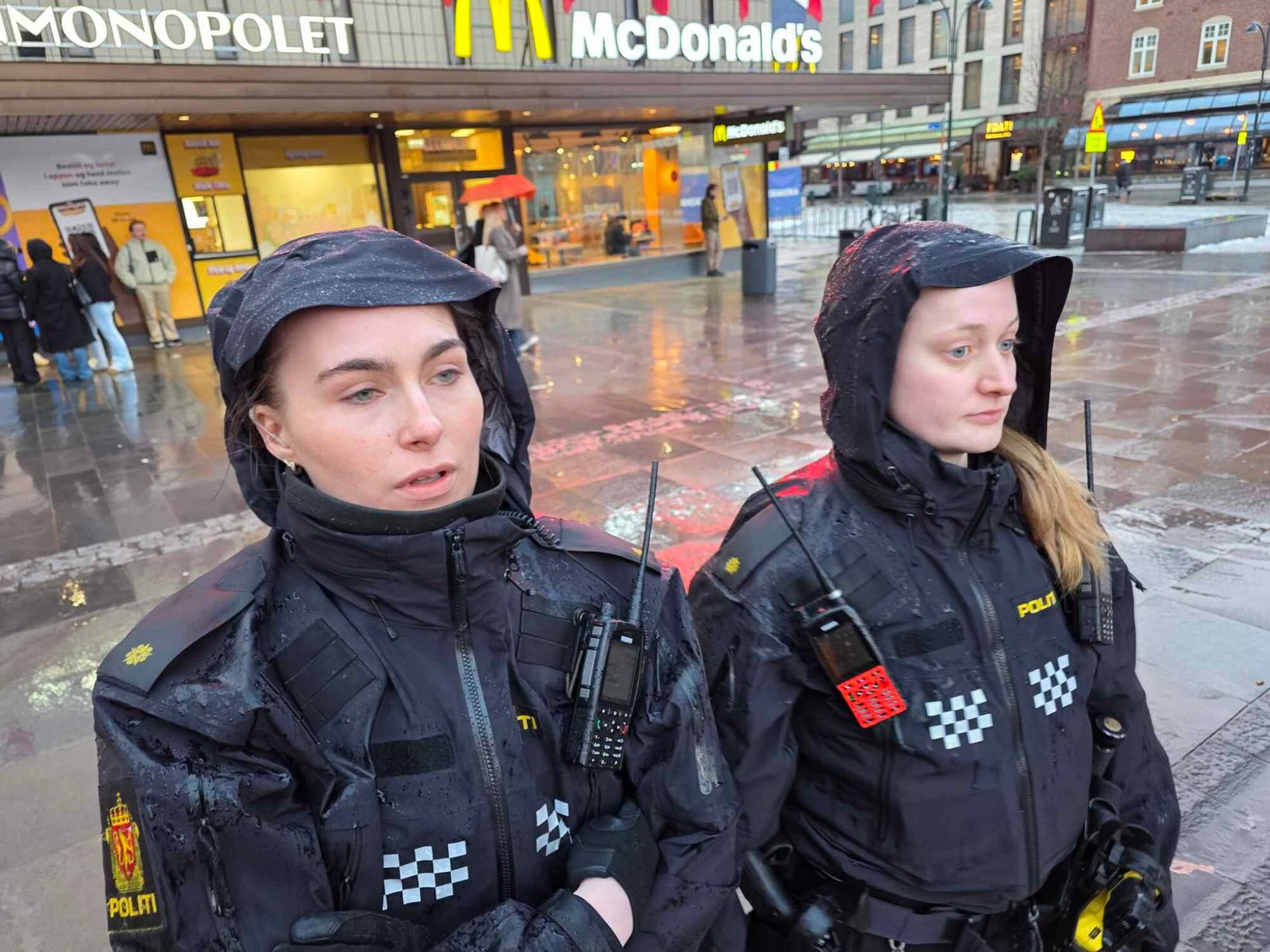 The policewomen who made the decision that Document’s journalist would not be allowed to continue photographing in the public space. (Photo: Bente Haarstad)
Also present at the demonstration was Veslemøy Lian. She has previously been fined a five-figure amount in connection with a demonstration for freedom of expression in Oslo. The imminent risk of being fined caused both her and Haarstad to leave the location.
Police leader doubts the account
Operations leader Svein Erik Wagnild of the Trøndelag Police District (Trøndelag politidistrikt) will not in any way comment on the police’s handling of Haarstad. He suggests that Document cannot be certain about what happened at the location and that our understanding of the incident may be incorrect.
The entire conversation with him is reproduced further down in the article.
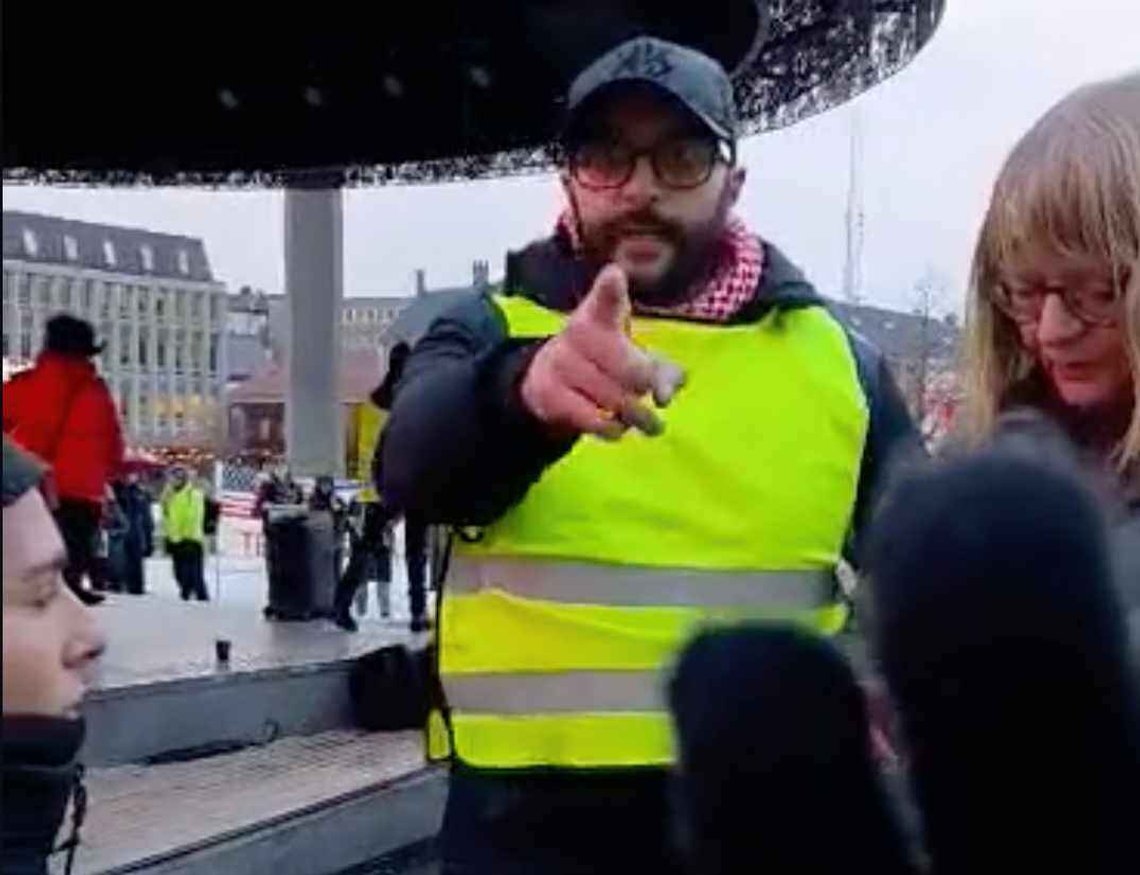 – You are not allowed to film. I will sue you, threatens Zuhaid Swaid while the police officers stand passively watching. (Still image from video.)
The demonstrator who first placed himself in front of Haarstad’s camera to obstruct her coverage of the demonstration was board member Lise Behne Eie of the Palestinakomiteen in Trondheim.
– It did not help to say that I was at work, says Haarstad.
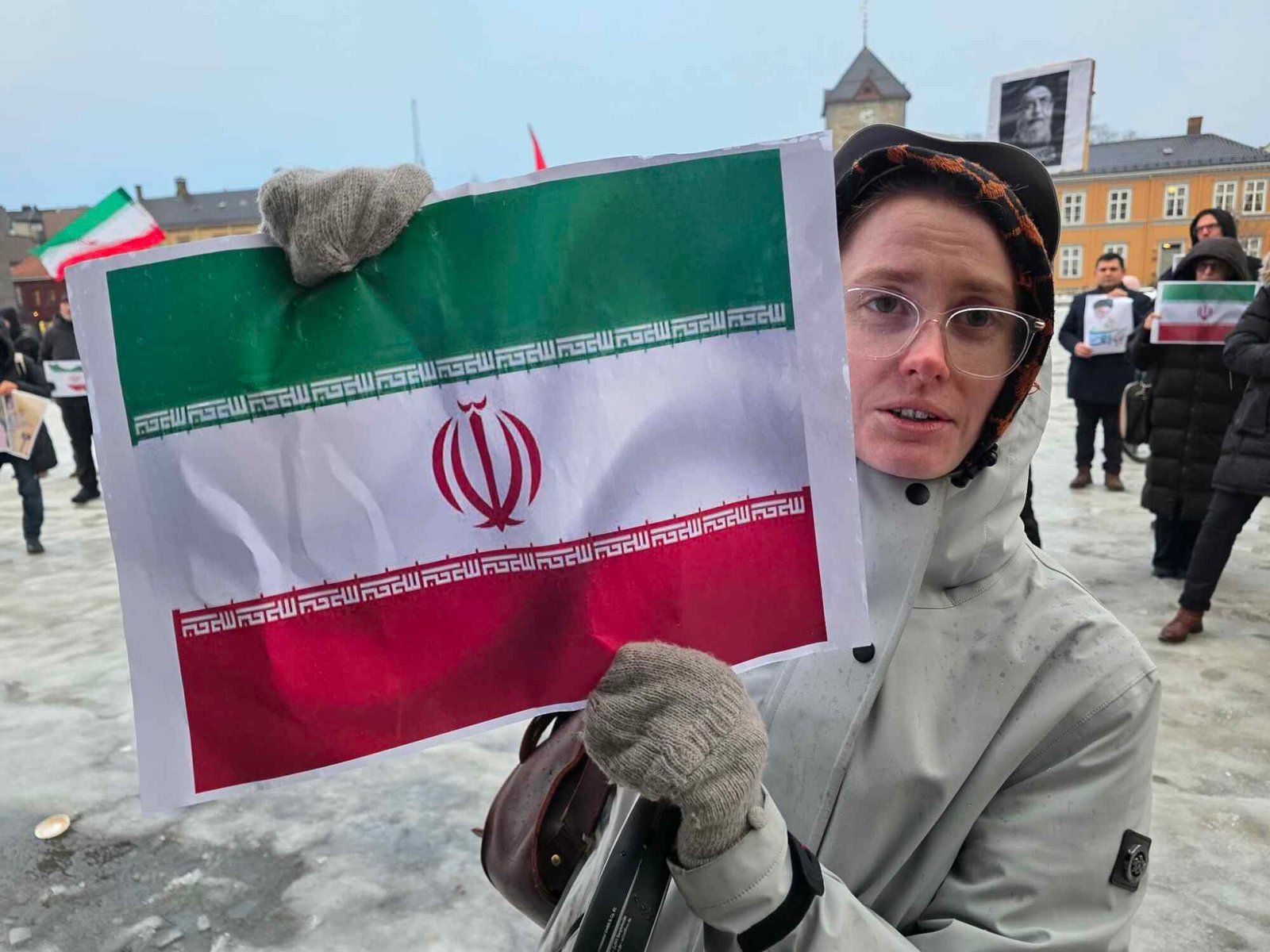 Lise Behne Eie attempts to prevent Document from photographing the activists present. (Photo: Bente Haarstad)
Behne Eie converted to Islam at the so-called Bryggemosque (Bryggemoskeen) in the city in January this year. The news was documented with video on Instagram.
Also present at the demonstration was Ap politician Karim Tahir. He has previously reported Document to the police after becoming the subject of journalistic scrutiny in Document’s columns.
Video: Veslemøy Lian
Mourning the deceased dictator
The gathering became both a memorial ceremony for the deceased dictator in Iran and a political demonstration against the attacks by the United States and Israel.
– Stop the war, condemn attacks on Iran, was one of the slogans during the demonstration, painted on a large banner held by two elderly Norwegian women.
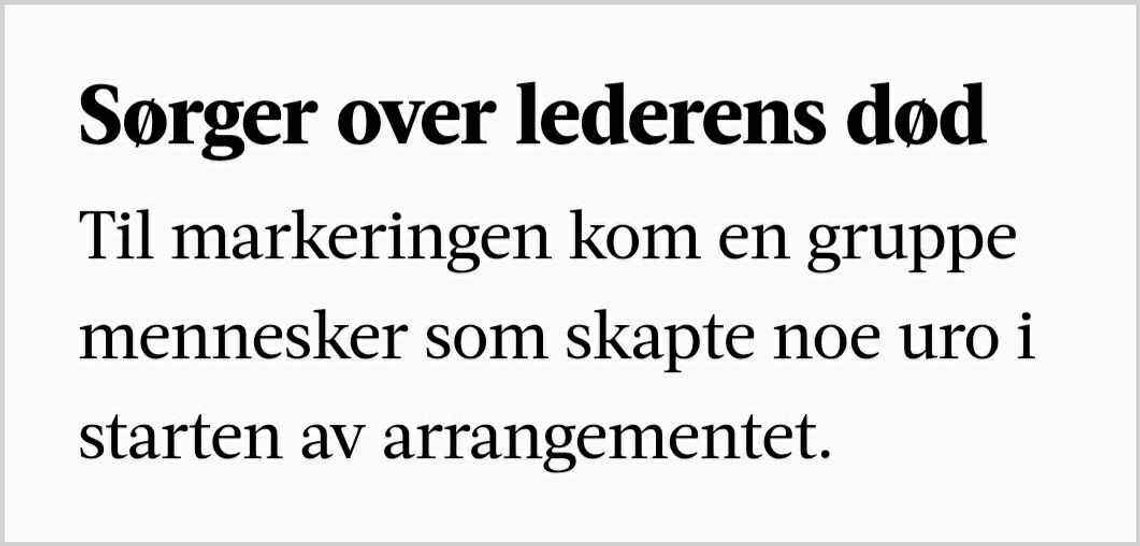 Adresseavisen’s journalist portrays it as if Document’s journalist participated in disturbing the memorial gathering for the Iranian dictator and created “some unrest”. (Facsimile: adressa.no)
– TERRORISTS was written on another banner, beneath the American and Israeli flags.
Israel’s flag had a painted skull in the centre. The stars in the United States flag resemble small bombs.
MDG politician Jonas Ali Ghanizadeh criticises the organisers for allowing regime sympathisers to participate. He writes that “to show up in Norway to demonstrate support for the clerical regime is a completely repulsive act”.
Subsequently it emerges that the organisers were critical of the Khamenei sympathisers who appeared. After deliberation they were nevertheless allowed to remain.
– Those with the pictures of Khomenei [sic] came and were originally asked to leave. After much back and forth, somewhat unpleasant arguing and discussion, it was decided that they could stay. All the speeches and almost all the other demonstrators strongly distanced themselves from and expressed disgust towards the regime in Iran. I myself gave a speech where I of course condemned the regime, but it was not easy to stand in front of those pictures. It filled me with aggression, writes Michal Nitter Weinmann-Wighammer in a comment beneath Ghanizadeh’s criticism.
In video from the event one can hear a speaker say that the activists “are here to show solidarity with the Iranian population”.
In its coverage, Adresseavisen highlights the Pakistani Shia Muslim Ali Nozori, who says that he is in mourning after the United States and Israel bombed his religious leader.
– I am in deep mourning that our supreme leader is dead. This is ideological support for Khamanei (sic). He is like a father to us, says Nozori.
– We are here to mourn and to show support for the clerical regime.
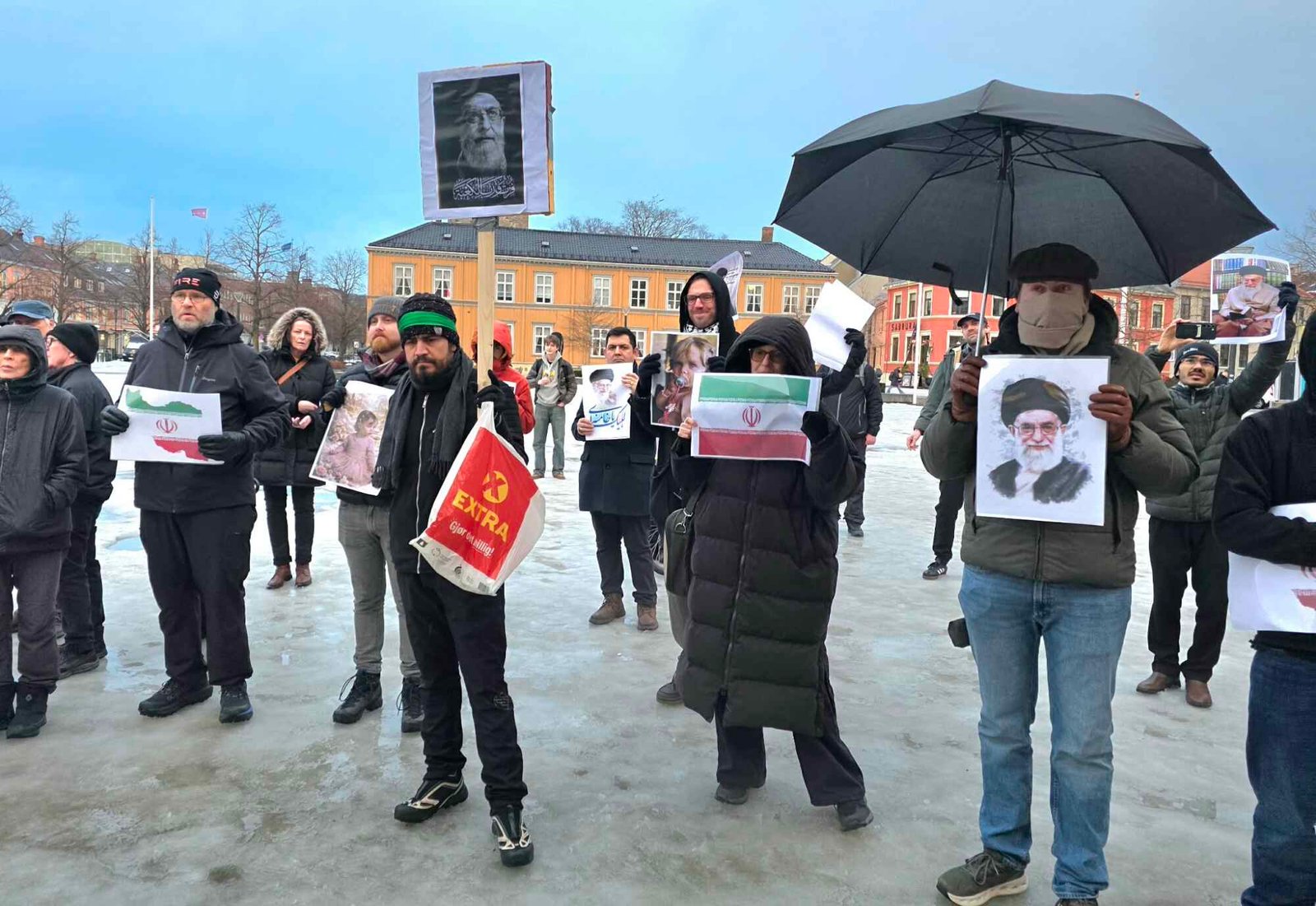 Ali Nozori (with green asabah headband) has appeared in the centre of Trondheim together with other demonstrators to pay a final tribute to his supreme Shia leader, Ayatollah Khamenei. (Photo: Bente Haarstad)
– The police also repeated what the Islamists said, that I could not take photographs directly up in people’s faces. Which I did not do, says Haarstad.
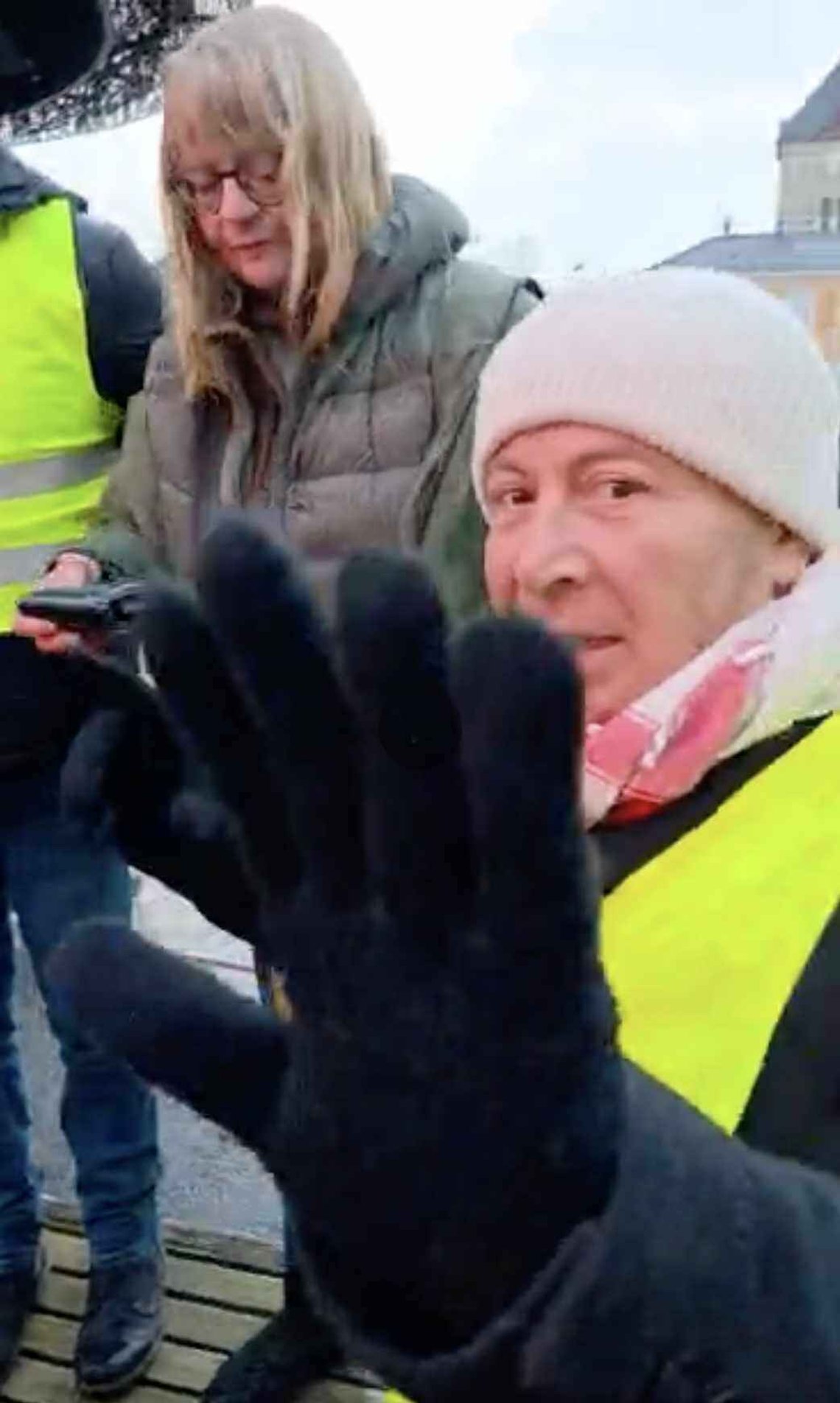 Professor at NTNU and member of the Palestinakomiteen in Trondheim, Bassam Hussein, repeatedly attempts to prevent journalist Bente Haarstad’s conversation with two police officers from being filmed. He also threatens to sue those who film. (Photo: Still image from video/Veslemøy Lian.)
NJ: – Not common
NJ leader Dag Idar Tryggestad emphasises that he is not familiar with the details and the concrete circumstances in this case.
– Norwegian journalists fortunately seldom experience what you describe. The police themselves must answer for their assessments during this demonstration. We have registered an unacceptable aggression towards the media in connection with some demonstrations in recent years. But fortunately this is not common when journalists behave professionally, says Tryggestad to Document.
– I have held a press card for several decades and have never received complaints about my conduct, is Haarstad’s comment.
– Are you entirely certain about what has happened?
Operations leader Svein Erik Wagnild of the Trøndelag Police District will not comment as soon as he hears why Document is calling.
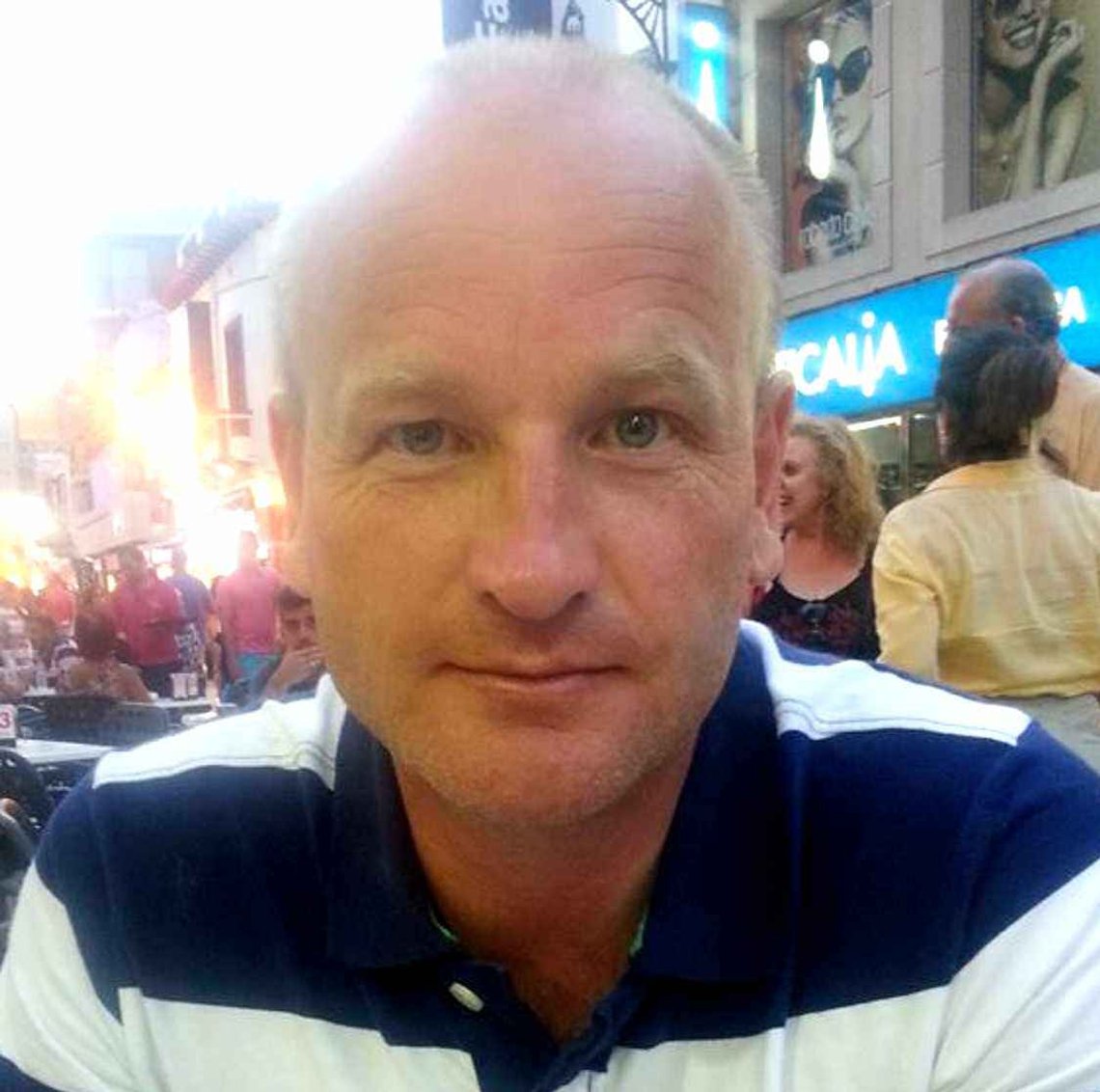 Operations leader in the Trøndelag Police District, Svein Erik Wagnild. (Photo: Private)
First he problematises that the switchboard has transferred Document to the wrong number, despite the fact that the switchboard operator has just conferred with him about the enquiry.
– I am very used to the media calling me on a special number they have been assigned, so it becomes difficult for me to relate to someone who says they are from the media when the number on my screen does not show that.
He nevertheless asks what the matter concerns and is given a description of the incident and the video material Document has seen.
– Why did the police not allow the journalist to do her job?
– Yes … but you, Hansson, are you entirely certain about what has happened here?
– I have seen the recordings and it was the demonstrators who went towards the journalist and tried to prevent her from taking photographs in a public place. One can understand that when they are demonstrating for such a bad cause as Iran, but should they not …
– But now we must distinguish between … now I must interrupt a little. I am not interested in participating in discussing types of views in the case; I am sitting here as operations leader and if you are going to ask me about things we must keep to factual … factual what actually happened. I am not interested in discussing … one thing or the other … politics.
– No, I will not put words in your mouth; I was presenting my account so that you know what information I have received and which corresponds with the videos I have seen and the audio recordings we have and pictures of the two police officers. So then I would like to hear whether the Trondheim police have any comments on the procedure where the journalist is …
– No, I have no comments on that right now regarding this request and I have no comment at all. If someone is not satisfied with the work that the police do they are very welcome to submit a complaint to the police.
– Is it the Norwegian Bureau for the Investigation of Police Affairs (Spesialenheten for politisaker) or the National Police Directorate (Politidirektoratet) that is the correct authority?
– Then you can complain to the Chief of Police in Trøndelag (Politimesteren i Trøndelag).
– On a general basis, should the police in Trondheim allow the press to do their job? You can answer that entirely generally.
– When it comes like that, Hansson, and when you call in the way you do, the police do the job we are supposed to do, and now I do not know whether Hansson has received … in a way all the facts in the case here. I will myself speak with the patrol officers to hear what has happened here. Therefore I say that you may contact us during daytime tomorrow.
The police state on their own website that complaints concerning police removal orders should be addressed to the Norwegian Bureau for the Investigation of Police Affairs (Spesialenheten for politisaker).
Facts about removal from a public place
The police may remove you if there is:
- Risk of disturbance of public order
- Risk of an offence
- Risk to the safety of others or yourself
- You obstruct the work of the police
- You do not comply with an order issued pursuant to law
It is sufficient that the police consider it necessary and proportionate. The measure must not be more intrusive than the situation requires (the principle of proportionality).
Removal normally takes place pursuant to Section 7 of the Police Act (Politiloven §7). When the police issue an order to leave an area, the rules of the Public Administration Act (Forvaltningsloven) also apply. All orders must be capable of justification by the police at the location. The police do not need to give a legal lecture on the spot, but they must provide a genuine and understandable reason.
Source: Politi.no
Read also:


