

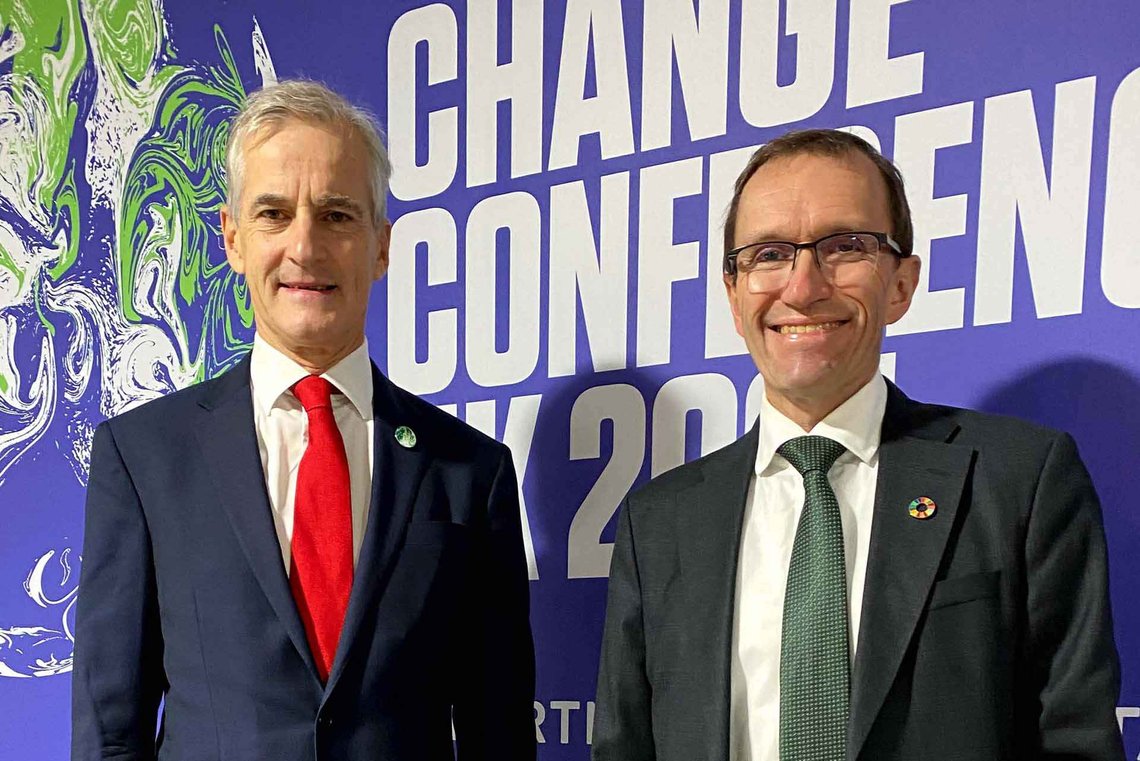
Jonas Gahr Støre has great difficulty in making the world hang together. He must balance between condemning the war against Iran while not becoming a defender of the religious dictatorship. He has great difficulty in justifying how the removal of a murderous regime constitutes an attack on “international law” (folkeretten). When set against the regime’s murders, the word becomes meaningless.
Støre appears as a cold fish. Even Christina Pletten in Aftenposten has been shaken by the regime’s conduct towards defenceless civilians. Such a regime has lost any legitimacy whatsoever. But Støre does not speak in this way. He believes the situation could become worse, in direct contradiction to what Iranians at home and abroad say: No, it cannot become worse. They want the regime gone, whatever the cost. They have passed the point of no return.
But not Støre. He argues against the Iranian people’s rejection of the regime. This becomes evident when he says that Iran acquired proxies abroad – Hizbollah, Hamas and the Houthis – in order not to have the war brought home. That is an incredible statement. The Shia Muslim crescent, as it was called from Tehran to Beirut, was a protection, a guarantee of the regime’s survival, not a plan to dominate the region. That is pure revisionism.
Obama was the one who approved Iran’s role as a great power through the JCPOA agreement, and this continued under Biden.
But concerns abroad increased. The regime continued with the enrichment of uranium.
Jeffrey Goldberg, the current editor of the Atlantic, asked Obama whether he was not aware that Hitler chose to prioritise the war against the Jews – that is to say, their extermination – rather than prioritising the war against the Soviets. Railway wagons that could have transported soldiers instead transported Jews to the gas chambers.
No, this was not something Obama was aware of, and he did not care to know it either.
Iran has therefore been able to continue its course towards the bomb.
Iran threatened Israel with annihilation and has done so since its founding. The regime was willing to sacrifice the nation in order to fulfil that objective. The costs were enormous. The population has long since understood the connection and no longer accepts being sacrificed. They see an inflation that causes wages to fall so much and prices to rise so much within a single day that they see poverty unfolding in real time. In that case they might just as well go to war against the regime, for they would not survive it anyway.
People must be pushed this far before they react.
Europe’s rulers are nervous. They know that they too are pushing their own populations and have long since downgraded them. The ordinary woman and man are placed further and further down the list of priorities, after immigrants – human rights for foreigners trump everything! That is why Støre continually speaks up international law – he must not surrender this trump card – for in its wake follow the war in Ukraine and the green transition – and the export of Norwegian fossil-free electricity and the reimport of electricity that holds Norwegian consumers in a vice – a weak krone caused by the lack of confidence abroad in the Norwegian government’s policy (they see the madness). Despite 20,000 billion in the bank, Støre does not steer the ship for the best interests of Norway but for his own projects. This is as with the clerical rule in Iran: Støre has relegated Norwegians so far down the list that it makes no sense, and abroad confidence in his ability to govern is being lost.
Støre suffers from megalomania. He is to defeat Trump and bring Norway into the EU.
Trump stands for everything Støre hates: real war.
Støre and his clique misread everything Trump does. When Trump removes the leader of the largest cartel – Venezuela’s president – NRK calls it a kidnapping, and Barth Eide invokes international law (folkeretten).
When J.D. Vance says that Europe is in the process of failing its ideals, Støre refuses to applaud. His media say that the national strategic plan is an attack on Europe.
Støre seduces and deceives. But he sits on borrowed time.
Trump’s policy makes visible which side Støre stands on.
Trump calls his bluff, as the expression goes. Støre is compelled to strike his flag. He cannot swallow that the United States triumphs and cuts off the head of the clerical regime.
Therefore Støre must elaborate on how dangerous the war is and how great uncertainty it creates.
He must conceal that this is a war of liberation. There is no doubt about what the Iranians want. They give thanks!
The mistake Iran made was to unleash the 7 October massacre. Støre and Barth Eide were unable to read that the rules of the game had changed.
But Israel understood that it was an existential struggle.
In this situation Støre, Barth Eide and NRK chose not to offer condolences to Israel and instead to recognise Palestine.
Støre and Barth Eide crossed the line and joined the anti-Western side.
Therefore the removal of the regime is also a blow against the strategy that Støre and Barth Eide pursue. Iran is the counterweight to Trump and Netanyahu. The leader of the Resistance Front.
Støre, Sanchez and Macron are de facto collaborators.
But they are unable to read the development.
The first major defeat for Iran was when Assad was overthrown. Or when the Iranian president and foreign minister went down in an air crash.
The decisiveness of Trump and Netanyahu takes them by surprise. They are completely disoriented.
A war of liberation is, for them, destabilising.
They de facto support a stability in which the murderers remain in power.
Støre and Barth Eide are not on the side of history.


