

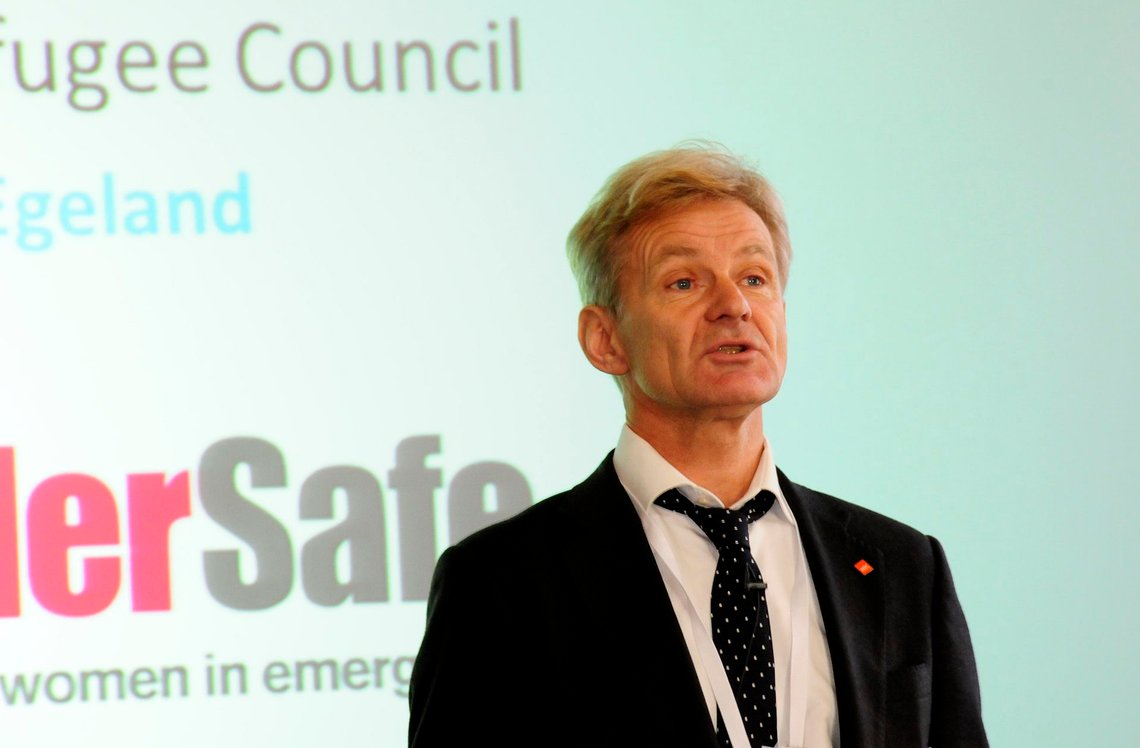
In 2024 Norway granted 19 million aid kroner to the Islamic Republic of Iran. The vast majority is channelled through the Norwegian Refugee Council, which is led by Jan Egeland (Labour). Norwegian aid commenced when Ayatollah Khomeini became the country’s supreme political and religious leader, and increased after the assassination attempt on the publisher William Nygaard.
Norway has been a stable donor of aid to the Islamic Republic of Iran for more than 30 years, while the recently killed Ayatollah Ali Khamenei has been the country’s political and religious head. Since the third Brundtland Government resumed aid in 1992, Norway has up to and including 2024 granted 671 million aid kroner to Iran.
In that way, the Islamic Republic has been able to release funds which it has been able to use for other purposes, such as financing terrorist organisations such as Hamas and Hizbollah as well as criminal groups operating in the West, including Norway. And not least to suppress its own population, of whom they have killed and tortured an estimated 50,000 so far this year.
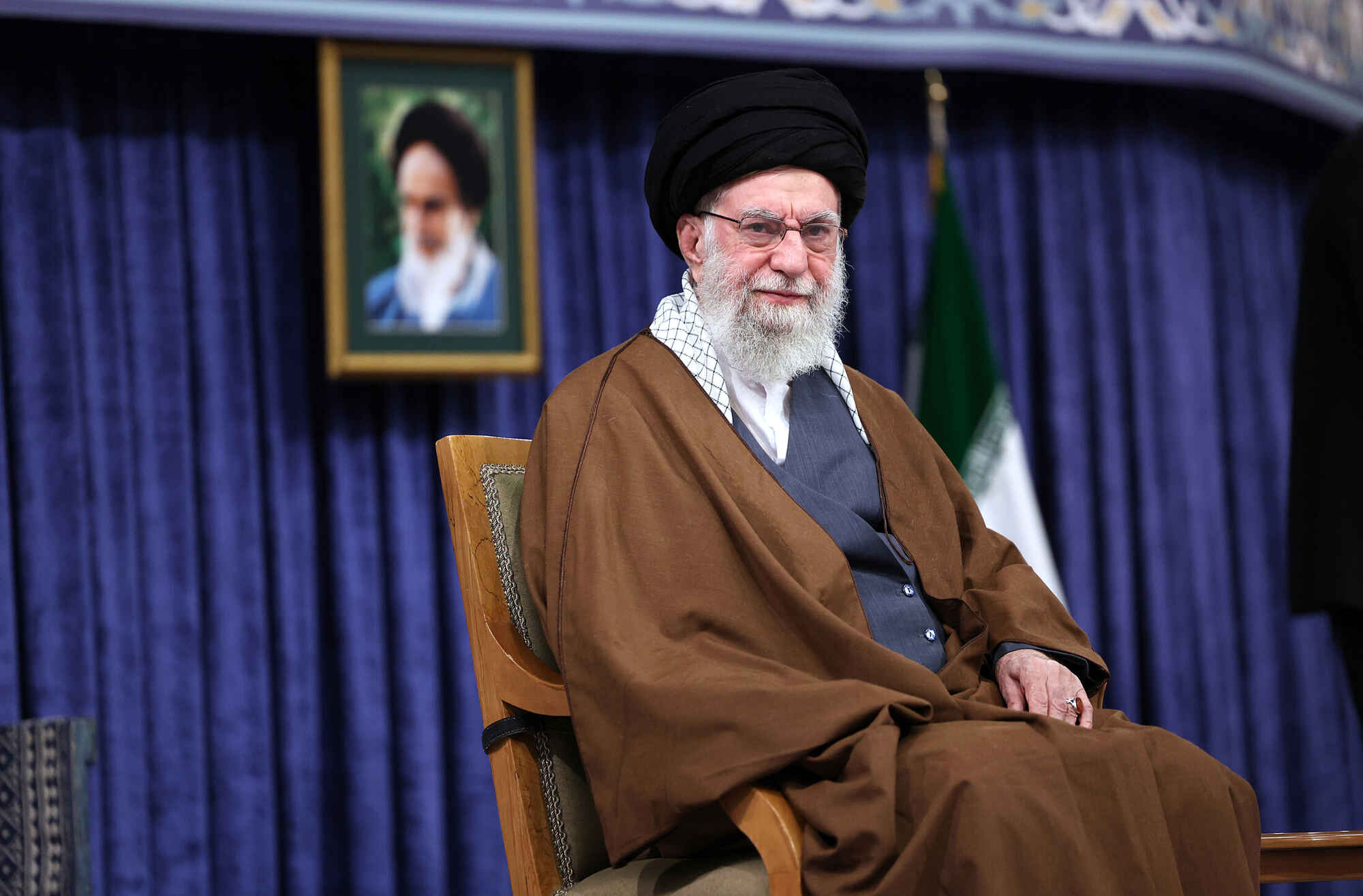 Much to thank Norway for. While Norwegian taxpayers have borne the refugee expenses, Ayatollah Ali Khamenei has been able to finance Hamas, Hizbollah and criminal networks. Photo: Office of the Iranian Supreme Leader via AP
Aid architect Jan Egeland
The majority of Norwegian aid has gone via the Norwegian Refugee Council, which is Norway’s largest NGO – i.e. a non-governmental organisation which nevertheless receives the majority of its funds from the state. The Norwegian Refugee Council has been led by Jan Egeland (Labour) since 2013.
Egeland was State Secretary in the period 1992–1997 under the Ministers of Foreign Affairs Thorvald Stoltenberg, Johan Jørgen Holst and Bjørn Tore Godal, when aid to the Islamic Republic of Iran went from zero to more than 15 million kroner annually.
The purpose of the aid has been to assist the Islamic State’s assistance to Shia Muslim refugees from Afghanistan, such as the Hazaras. Since the communist coup in 1978, and later the Taliban regime in Afghanistan, Iran has opened its borders to this minority, owing to geographical proximity, common language (Dari/Persian), cultural ties and religious affiliations.
Ergo, the Islamic Republic of Iran has practised a refugee policy that is diametrically opposed to that whereby Norway has received hundreds of thousands of culturally distant refugees who share neither linguistic, cultural nor religious commonalities with the Norwegian population. Norwegian taxpayers have assisted the regime in Tehran in this, through the Norwegian Refugee Council, under the leadership of the architect of the aid: Jan Egeland.
Do not ride on the same day as they saddle
The figures on which we base ourselves are obtained from Aid in Figures (Bistand i Tall), on Norad’s website. The figures are shown up to and including 2024.
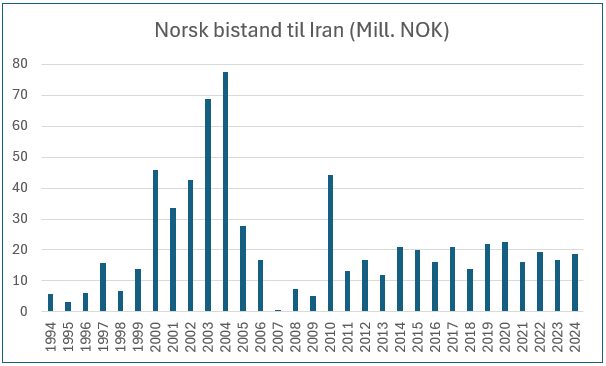 Aid to Iran was resumed under Brundtland III in 1992. Source: Norad
Document.no has contacted Norad with questions as to how much was granted in aid to Iran in 2025 and what is budgeted for 2026. As usual, we were asked to send the question by e-mail, which we have done. It is standard procedure that even the simplest questions must be sent by e-mail.
Since Norwegian ministries and directorates cannot answer even entirely uncomplicated questions directly, nor do they ride on the same day as they saddle, we shall provide information about the answer in a possible follow-up article.
The history of Norwegian aid to the Islamists
In total, Norway has given close to 700 million kroner in aid to the Islamic Republic of Iran, primarily since 1992. Some smaller amounts were granted in the period 1964–1975. Thereafter there was zero in the years 1976 to 1979.
But after Ayatollah Khomeini had taken power and Gro Harlem Brundtland (Labour) became Prime Minister in Norway, aid to Iran was resumed. When Kåre Willoch (Conservative) became Prime Minister in 1981, he put an end to this. While Brundtland managed to dispatch half a million kroner in 1980–81, Willoch succeeded in halting the aid, such that the total amount for the period 1982–1986 was only NOK 24,000.
But when Gro Harlem Brundtland again assumed the office of Prime Minister in 1986, after Willoch’s vote of confidence (kabinettspørsmål) on increasing petrol duty in order to compensate for the loss of state oil revenues in the wake of the oil price fall, Brundtland nevertheless implemented what Willoch had demanded. Some of the money was used to resume aid to the Islamists. Presumably she was inspired by her great role model, the Swedish Prime Minister Olof Palme, who was a warm supporter of the regime of Ayatollah Khomeini.
In the years 1987–1990, the Brundtland II Government committed itself to granting more than five million kroner in aid to Iran, before Prime Minister Jan P. Syse (Conservative) once again succeeded in halting this flow of funds. In 1991 aid to Iran was equal to zero.
But it did not last long. When the Syse Government collapsed over the EEA negotiations, Gro Harlem Brundtland became Prime Minister for the third time. In 1992 she set in motion once more, with aid to the Islamic Republic as never before.
In 1993 the publisher William Nygaard, who had published the book “The Satanic Verses” by Salman Rushdie, was subjected to an assassination attempt which he barely survived. The traces pointed towards the Islamic Republic of Iran, where Ayatollah Khomeini had issued a fatwa – a death sentence against the author and all who contributed to publishing the book, i.e. also William Nygaard. This had no significance for the Brundtland Government. For the following year Norway set a new record in aid to Iran, with more than five million kroner. Thereafter it has increased. In the period 1992 to 2024, the Islamic Republic of Iran has received 671 million aid kroner from Norway.


