

In 2025, Norsk Journalistlag received NOK 10.5 million from the Norwegian aid budget. Since 2013, NOK 92 million in aid funds have accrued. In addition, Institutt for Journalistikk and the SKUP Foundation have received aid funds from Norad, bringing the total to NOK 141 million. This is more than the International Peace Institute received under Terje Rød-Larsen, and must not be confused with press support.
In the wake of the United States Department of Justice recently releasing additional Epstein documents, charges of corruption have been brought against several Norwegian foreign policy leaders and former senior politicians.
According to figures from Norad, the International Peace Institute (IPI), under the leadership of Terje Rød-Larsen, received NOK 128 million from the Norwegian aid budget. This naturally draws attention to Norwegian aid policy and what the aid budget is used for.
Aid for journalism
The majority of Norwegian aid is sent to multilateral organisations such as the UN and the World Bank, or bilaterally to recipient countries. But of the vast Norwegian aid budget of nearly NOK 57 billion, approximately NOK 12 billion is distributed to around 500 so-called non-governmental organisations domestically and abroad. One of these was Rød-Larsen’s IPI.
Of the 95 Norwegian non-governmental organisations that receive aid funds, Flyktninghjelpen, Norges Røde Kors, Kirkens Nødhjelp, Redd Barna Norge and Norsk Folkehjelp unsurprisingly top the list. These five received NOK 5.2 billion of the NOK 7.7 billion in aid funds that in 2024 ended up in the coffers of Norwegian non-governmental organisations. Thus, NOK 2.5 billion was distributed among the remaining 90. Document refers here to 2024 figures, as final 2025 figures are not yet available.
A preliminary review has caused Document to raise its eyebrows. Questions as to the purpose and justification for why this is a task for Norwegian taxpayers to finance arise naturally.
Something that arouses curiosity is that three organisations linked to Norwegian journalism receive funds from the aid budget. This must not be confused with press support.
More than to Rød-Larsen’s IPI
When Børge Brende took office as Minister of Foreign Affairs following the election in 2013, Norsk Journalistlag (NJ) received its first NOK 5 million. In 2021, when Espen Barth Eide took over as Minister of Foreign Affairs, the aid increased further. According to figures from Norad, NJ received a total of NOK 81.6 million in aid funds in the period 2013–2024.
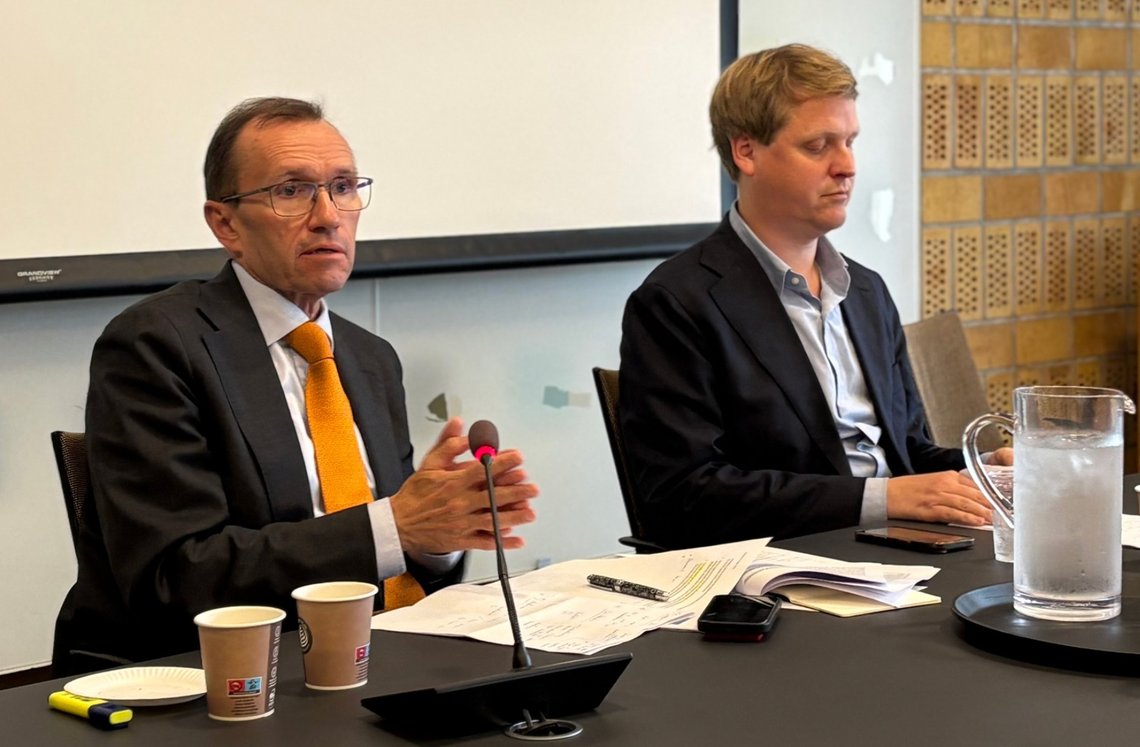
 When the current Managing Director of WEF, and friend of the late Jeffrey Epstein, Børge Brende assumed office as Minister of Foreign Affairs, the allocation of aid funds to Norsk Journalistlag commenced. Here during NHO’s annual conference on 7 January 2026.
Photo: Heiko Junge / NTB
International adviser at NJ, Eva Stabell, states that they also received NOK 10.5 million in 2025. This brings the total to over NOK 92 million for the period 2013–2025.
However, she adds that the figures from 2021 onwards also include aid funds that NJ channelled onwards to Institutt for Journalistikk (IJ) and SKUP – Stiftelsen for Kritisk og Undersøkende Presse. The latter two had by then already received aid funds from the Ministry of Foreign Affairs/Norad totalling NOK 49.3 million in the period 2005–2020.
This means that NJ, IJ and SKUP together have received over NOK 141 million since 2005. Thus, three central organisations in the Norwegian press have received more aid funds than IPI received under the leadership of Terje Rød-Larsen.
Institutt for Journalistikk (IJ) describes itself as “Norwegian media’s own competence centre” and is located in Pressens hus in Oslo. “We deliver professional replenishment in the form of courses, seminars and conferences,” they write on their website.
– Never in the world
According to Stabell, the funds that the Journalists’ Union disposes of are used for local training, conferences and workshops for journalists in South Asia, the Middle East and North Africa. Document concludes that of the NOK 5.8 million in aid funds that in 2025 were disposed of by NJ, approximately NOK 4.5 million were used for local training, while NOK 1.3 million were used for administration, including her salary.
 Eva Stabell at Norsk Journalistlag disposes of the funds. Photo: NJ
Stabell was previously a journalist at NRK, but has been employed full-time as international adviser at Norsk Journalistlag since the allocations began in 2013.
– Never in the world, she replies when Document asks whether the aid funds may have influenced Norwegian journalism concerning Norwegian aid policy.
– Støre has stood at the lectern and boasted of our projects, she adds.
According to Stabell, it concerns freedom of expression and freedom of the press, and security for journalists under distant skies. She distributes the funds to what she describes as a “gang of journalists from the various journalists’ unions” in the above-mentioned regions. The local courses are, according to Stabell, conducted by local course leaders whom NJ has previously trained.
She is now awaiting a response to the application for new allocations from the Ministry of Foreign Affairs/Norad. She is very concerned with aid and that it is now particularly important, since the Trump administration has discontinued US Aid.
Export of Norwegian journalistic method
– The funds that have been granted to IJ are used for practical courses in quality journalism (corresponding to courses that IJ holds for Norwegian journalists) for, inter alia, the following partners: Jordan Media Institute, Radio Rozana, Arab Researchers for Managing Forums and Training (ARIJ), Filastiniyat, writes Chief Financial Officer Lars Brekke at Institutt for Journalistikk, in an email to Document.
In 2025, IJ received NOK 2 million for this purpose.
Institutt for Journalistikk has conducted a long series of courses, seminars and workshops for journalists, editors and media students from across the Middle East over the past nine years.
– The funds have been used to support teaching in investigative journalism for journalists and editors in Asia, the Middle East and Africa. The money has been used so that journalists from countries in these parts of the world could travel and participate in conferences in the region to which they belong, in addition to a global conference every other year (GIJC), and international workshops linked to SKUP and Data-SKUP, writes Linn Thorkildsen, Managing Director of SKUP.
This means that the aid funds, after costs and salaries for administration have been deducted, go towards exporting Norwegian journalistic method. The following diagram shows the development of aid funds to Norsk Journalistlag, Institutt for Journalistikk and SKUP.
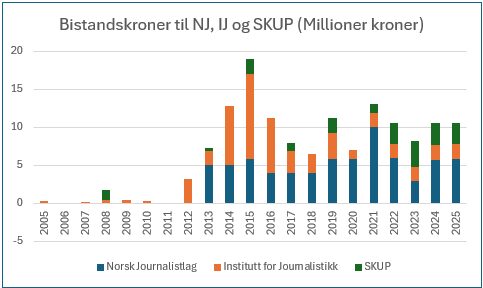 Aid funds to Norwegian journalism. Source: Norad, NJ, IJ, SKUP
We leave it to the readers to assess whether Norwegian journalism is an export commodity for which Norwegian taxpayers should foot the bill.


