

How are we perceived on the other side?
In the years after the Second World War, efforts were made on the Allied side to ascertain what might have been done better in order to bring the war to an earlier conclusion, with fewer losses and costs. The British war historian Sir Basil Liddell Hart was among those who interviewed captured German officers, and he uncovered much of interest, including that the war, according to the Germans themselves, could have been concluded as early as 1944 had the Allies exploited the opportunities available to them in a more creative and less dogmatic manner. The criticism was directed in particular at Generals Eisenhower and Montgomery, who adhered strictly to the old strategic textbooks, in contrast to the more free-thinking and effective General Patton.
What is less well known is that similar inquiries were in fact attempted in the first years after the fall of the Soviet Union, but nothing was ever published on the matter. The insight that was gained into late-Soviet thinking and missed Western opportunities might not have sounded so pleasing in the ears of Western leaders. Today we struggle on both sides with the after-effects of ineffectual political leadership, missed opportunities and catastrophic strategic misjudgements which for a long time will cost astronomical sums of money and countless human lives. Why did we learn nothing?
There were many questions that on the Western side one was concerned to have answered when dialogue with highly placed Russian officials began in the 1990s. One of them was to gain closer insight into what on the Soviet side had particularly been emphasised as strategic threats that it was decisively important to monitor and retain the ability to control. High on the list came a widespread fear that the West, and especially NATO, could by simple means cut off the Soviet Union’s access to the world’s oceans.
Virtually regardless of whom we as Norwegian officials spoke with at a high level in the Russian administration, they expressed that this was a consideration they would place high on the list of potential and current threats to the country’s security. But was this understood and taken into account on our side? Yes, to some extent and for some years this perspective formed part of the deliberations underlying Norwegian reassuring and de-escalatory measures in the High North, both military and civilian. Both the negotiations on the Barents Council (Barentsrådet) and the Arctic Council (Arktisk råd) had from the Norwegian side a clear purpose of building up a trust-based regional cooperation which over time would reduce the old antagonisms and through experienced results and advantages integrate the Arctic regions into mutually beneficial cooperation.
The Russians had throughout the Cold War pointed out as underlying threats that the exits both from the Black Sea and the Baltic Sea are closed, while only the opening towards the Pacific from Eastern Siberia is entirely open. In the north, access to the Atlantic is to a considerable extent controlled and dependent upon the special neighbourly relationship with Norway, which admittedly was subject to a number of reassuring politically determined restrictions on disposition and conduct that had real significance in dampening the fear of strategic challenges. But they were afraid that this could easily change to their disadvantage.
A central element in all strategic conduct and cognition is, in short, the insight one has or can obtain into what is known and how reasoning proceeds on the other side of the border. That is one of the purposes of intelligence and provides the basis for influencing the other party with information that may be real and true, possibly false and misleading. In any event, one will in strategic choices take account of the other party’s knowledge and insight and ensure that it does not lead developments astray. Our public news landscape forms part of this strategic game. It is therefore constantly important to be aware of how on the other side what is said and written is perceived, and what dispositions it leads to among our neighbours.
What signals do we send to the other side?
At the beginning of February we could read reports that the Government had invited the EU’s High Representative for Foreign Affairs, Kaja Kallas, to the conference Arctic Frontiers in Tromsø. The event was duly reported in the news media, including Forsvarets Forum, which is diligently used by Norwegian authorities to keep the Russians informed about Norwegian defence policy. Here we could among other things observe Kallas declare that she had become “… convinced that the EU must do more for the defence of the High North. It is impressive to see how they are working to defend the Arctic. At the same time, it is clear that we all must do more. Security in the Arctic has never been more important to safeguard. The EU is now working on a new strategy for the Arctic.”
It does not require much imagination to envisage that news items such as this, which were simultaneously adorned with naval visits together with Norway’s Prime Minister, occasion assessments of strategic significance on the other side. We may safely conclude that precisely that was also the intention, and it was conveyed in plain language. The EU says it wishes to engage militarily in the High North, and work on a strategy for this has been initiated. Our first question is therefore: Why is this message arranged in this manner precisely now? What reaction is it that one in this way is ordering from the other side?
We may envisage several answers, but in a military-strategic context this appeared first and foremost as a veiled warning of something on the other side that ought to be taken seriously: the EU, with assistance from Norway, is entertaining thoughts of preparing the opening of a possible new line of conflict in the High North. The motive the EU might have for sending the Russians such a signal is obvious. The war on the southern front is not proceeding in the desired direction, and in this situation it could be advantageous to create a need to divert the disposition of attention and resources. A problem not mentioned is that the EU does not possess a military organisation or command structure capable of presenting a real military threat in the north. Creating such a threat image would therefore have to be left to Norway. Are our authorities prepared to render the EU such a service, and if so for what consideration in return? Do we discern the outline of “favourable terms” for rapid membership negotiations?
The Russians have reason to wonder, but military strategists do not hesitate to interpret power language and strategic smoke signals in the worst possible sense. They are moreover aware that Kallas has been brought up with the most intense Russophobia the Baltic countries can display. The Russian Northern Command must therefore be assumed to have its possible countermeasures ready. Whatever dispositions they make as a consequence of the threats will on the EU’s and Norway’s side be seen as confirmations that we are faced with a real threat. That it is we ourselves who have arranged this situation in a thoughtless and militarily meaningless courtship of the EU will scarcely be mentioned in the news.
But the Norwegian sabre-rattling does not stop there. In connection with the Security Conference recently held in Munich, it was widely reported that Norway and Germany signed an agreement on closer defence cooperation, where once again attention is directed towards the High North. “Today we look ahead to further strengthening maritime deterrence on the front line in the North Atlantic and in the High North,” stated Germany’s Defence Minister Boris Pistorius during the signing of the agreement.
Again we must ask what on the Russian side is thought about news such as this. Is it unreasonable to assume that they instruct their planners to assess what significance this cooperation and other measures on our side may have for their security, including access to the world’s oceans, and what measures such a threat ought to occasion from the Russian side? Is there anything unexpected or strange in the fact that the Russians have now initiated readiness exercises in the north? According to the textbook of military-strategic thinking, that is exactly what we could expect.
And yet another question: Is it not reasonable to assume that precisely this reaction from the Russian side was part of the purpose both of the Norwegian-German agreement and of the political exploitation of the conference in Tromsø? Our leaders, or their advisers, are surely not entirely absent-minded when it comes to strategic deliberations and foresight, and in that case the Russian reaction will have been self-evident to those who directed the negotiation processes both from the civil and the military administrative apparatus.
What we are left with as unknown is whether on the other side one feels assured that this concerns political shadow-boxing or whether there might be more disturbing motives behind the messages now conveyed in rapid succession via our news media? What their intelligence otherwise captures, we know less about, but as with us it is an important element in preparedness against security threats.
The rules-based world order and the High North?
Over the past year, the notion of a “rules-based world order” has occupied a central place in the news landscape, together with frequent references to the provisions and regulations of international law, which in fact constitute the legal background to the expression. The need for an international legal framework that regulates and sets limits on states’ conduct and exercise of power has for centuries been sought to be met through agreements and treaties which we collectively call international law. But despite many well-intentioned attempts, international law has shown itself to have limitations in its ability to create a rules-based world order. It presupposes that all members of the international community see themselves as served by having a common understanding of the regulatory framework and refrain from any temptation to exploit the system to their own advantage at the expense of others. It is here that it has failed, and we see it today most clearly within the organs of the UN and in international economics and trade.
The two world wars in the twentieth century both gave impetus to attempts to prevent the recurrence of such humanitarian catastrophes as war always entails. It was believed, both regarding the League of Nations and the UN, that if the nations of the world were willing to renounce war as a political instrument, humanity would enter a new historical phase founded upon peace, freedom, development and prosperity. Today we may conclude that these were unrealistic hopes. But have we taken on board why the world was not able to live up to either the League of Nations’ or the UN’s declared purposes and principles for inter-state cooperation and harmony? Have we taken on board why the UN’s Universal Declaration of Human Rights never became anything other than a document in the archives of the member states?
The short answer is that everything we invest in the notion of a rules-based world order applies only to those states which, in accordance with their culture, history and self-interest, see themselves as served by such an order. But today these founders of the humanitarian international legal order no longer have a majority and power in the organs they created to safeguard it. It did not take the UN more than a few years to create a dominant majority of member nations which did not even intend to comply with the Declaration of Human Rights, but subscribed to their own alternative.
A rules-based world order presupposes that the world unites around a common set of international laws and rules which they not only subscribe to in principle, but which they in their own interest seriously follow and accept that others follow. That presupposition is today no longer present in the conduct of international intercourse. It is the recognition of this fact that underlies the United States’ revolt against those who do not follow the agreed regulatory framework, but who have insinuated advantages for themselves by manipulating the rules and living by their own. Why, for example, is there no one in the political milieu who finds it strange that it is precisely Communist China that outcompetes Western industry through the gross exploitation of its own working people?
The financing of terror has never been more extensive than it became after the UN Security Council in 2001 unanimously adopted Resolution 1373, which prohibits any form of financing and other support for terrorism. It was adopted pursuant to Chapter VII of the UN Charter, which renders it binding upon all member states. But its effect vis-à-vis the world’s growing terror threat is identical to zero. For the Jewish state of Israel, the activity within the organs of the UN over many decades may be compared with a persistent and unstoppable “Wannsee Conference” whose principal purpose is to destroy the Jews’ homeland and its Jewish population. That is where the “rules-based world order” has arrived. Today it is power that prevails at all levels of international intercourse, not international law. It remains only for some to acknowledge that this has consequences all the way up in the High North.
Russia is not a political mayfly
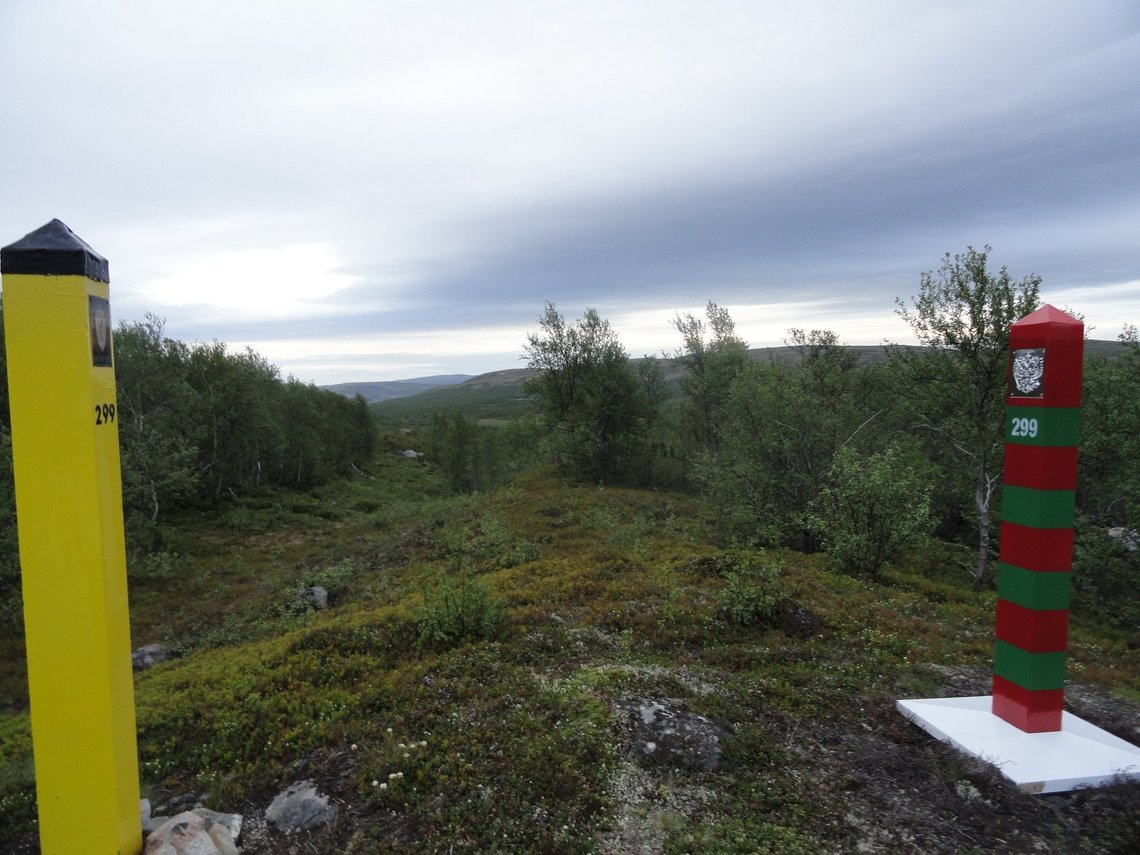
One may have different opinions about the conduct of the war in Ukraine. It has much in common with old-fashioned trench warfare. It also has similarities with historical attempts to conquer “Lebensraum” in that part of the world. As we in our own part of Europe these days commemorate the 200th anniversary of the conclusion of the Norwegian-Russian border treaty, it is timely to recall that this concerns the only border between the old European states where no war has been fought between the two adjacent nations.
But is it this happy tradition we now glimpse an end to? Again we must ask how on the other side of the Atlantic we are perceived when our closest ally in the Armed Forces’ own medium is portrayed as “fascist”.
That was the expression the acting news editor of Forsvarets Forum, Mikael Hem, used about Foreign Minister Marco Rubio’s speech at the Security Conference in Munich, and it was linked to the Christian roots to which he referred:
But Rubio also emphasised a religious and spiritual community. He underscored common language, the Christian faith and “what our forefathers sacrificed for the common civilisation we have inherited”.
– We are bound together spiritually and culturally, he said.
In the tribute to a common civilisation one senses a notion of brotherhood and religious unity in which individual deviations and foreign elements are destructive. One people, one faith. A hint of fascism.
We understand that the Americans have a need to look with new eyes at the Atlantic Alliance. It has not outlived its role, and no more is required to reassure the Russians than that the United States places one of its carrier strike groups in the North Atlantic. But cooperation presupposes that we on our side are willing to contribute to continued calm in our own area, and do not succumb to the temptation to place this vulnerable region at the disposal of someone who has other motives and needs. The nation’s security must never become a pawn in politicians’ game to obtain favour in the EU.


