

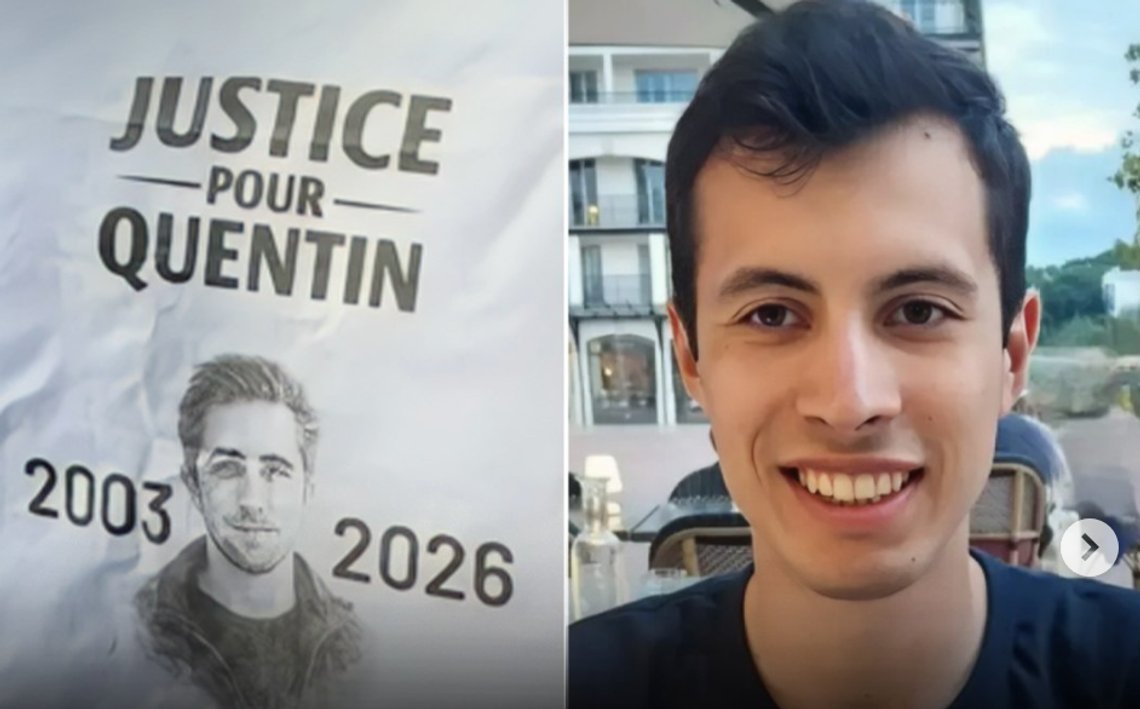
A young, conservative man has been murdered by left-wing extremists in France. Masked perpetrators kicked the 23-year-old student Quentin Deranque to death on a street in Lyon when he tried to protect women in the feminist group Némésis, who were demonstrating against anti-Semitism and Islamism.
The perpetrators came from circles around Jeune Garde – The Young Guard – a left-wing extremist group. The founder Raphaël Arnault today sits as an elected Member of Parliament for the far-left party La France Insoumise (LFI). It is one of France’s largest parties. After the murder, party leader Jean-Luc Mélenchon defended himself by saying that the party is opposed to all violence, and that it is they themselves who are being attacked.
The Minister of Justice Gérald Darmanin, by contrast, was clear: It is the political rhetoric on the extreme left that leads to unrestrained violence. The accusation is directed not only at the concrete perpetrators, but also at the milieu that has nurtured them.
Meanwhile, antifascists are occupied with praising the murder and tearing down posters in memory of the young, courageous Frenchman who died for a good cause.
PET Raises the Alarm
What unfolded on a street by the River Saône is not a phenomenon unique to France. Here in Denmark, the Danish Security and Intelligence Service has just raised the threat level from left-wing extremists. This emerged after Mikkel Bjørn from Dansk Folkeparti (DF) recently put a question to the Minister of Justice.
Politiets Efterretningstjeneste (PET) describes a milieu with significant organisational capacity.
Left-wing extremists can coordinate actions, mobilise large groups rapidly and dox political opponents. That is to say, they collect and publish private information about individuals with the aim of intimidating them and paralysing them politically.
At the core of the milieu are smaller groups of what PET refers to as “violence-ready individuals”.
For several years, the left-wing extremist milieu has primarily directed its actions against those whom it itself defines as right-wing extremists. Now the target group is being expanded.
According to PET’s assessment, the enemy image increasingly also encompasses Danish politicians and businesses that are spoken of negatively in connection with, for example, the conflict in the Middle East. That makes the threat more unpredictable. One no longer knows who the next target is.
Radicalisation in Gaza and the Climate Struggle
Two new issues are driving the radicalisation forward.
The pro-Palestinian agenda has united parts of the left-wing extremist milieu across internal divisions, and created a platform for concrete action.
The climate struggle pulls in the same direction.
Both agendas are linked to traditional left-wing extremist narratives about anti-capitalism and anti-imperialism, and this provides the movement with new pretexts and new recruitment.
PET assesses that there is an increased risk of spontaneous violence during demonstrations, and that acts of sabotage against critical infrastructure, businesses or symbolic targets constitute the most likely left-wing extremist terror scenario in the somewhat longer term.
The left-wing extremist milieu in Europe has generally grown. International connections strengthen the Danish networks. And the organisation takes place largely online, without a clear structure or a distinct hierarchy, which makes it more difficult to map and suppress.
The Moral Disguise of Violence
The violence of the left has a particular characteristic: It never presents itself as violence. It presents itself as self-defence, as anti-fascism, as the necessary course of history.
“Antifascism” has become a rubber category that can be stretched to encompass anyone one wishes to combat. Assaults on non-violent members of Génération Identitaire, the murder of Charlie Kirk, and now the young Quentin Derangue, who wished to protect women.
One may imagine the reactions if a right-wing parliamentarian had founded an organisation whose members were suspected of a political murder.
PET’s warnings oblige. The authorities must investigate the left-wing extremist networks as consistently as they investigate all other forms of organised political violence. Democracy is not dismantled with one great blow. It happens gradually, as violence is normalised when it is wrapped in the correct language.


