

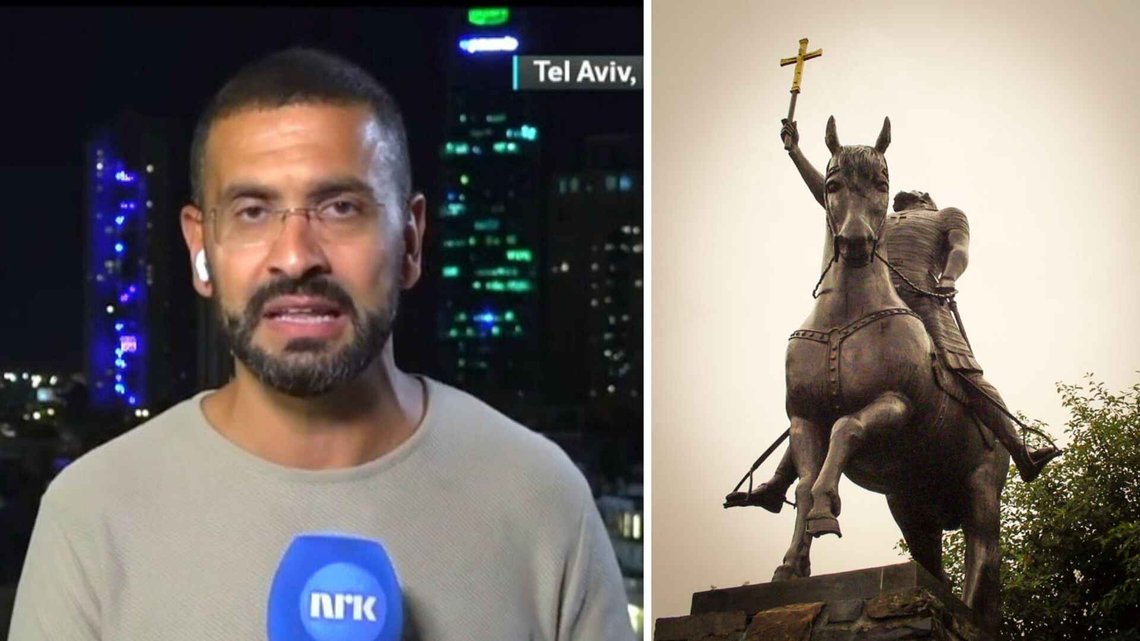
Yama Wolasmal has been named Årets Stiklestadprofil (Stiklestad Profile of the Year). As a Muslim born in Afghanistan, he will attend as the guest of honour at Stiklestad Nasjonale Kultursenter during the Olsok celebrations at the end of July. In 1995, the Storting (Norwegian Parliament) gave the centre in Trøndelag national responsibility for disseminating knowledge about St Olav the Holy, the Battle of Stiklestad, and the part of Norwegian history connected to these events.
According to the Stiklestad Nasjonale Kultursenter‘s website: “This year’s Stiklestad Profile, Yama Wolasmal, has for many years been one of the country’s leading journalists, with prominent roles at both TV2 and NRK.”
It continues: “As NRK’s Middle East correspondent, he has reported on conflicts and political upheavals in the region. His frontline coverage of the war between Israel and Hamas – including his confrontational interviews with leading figures from both sides in the programme Yama utfordrer – has earned him widespread recognition both in Norway and internationally.”
The national centre for the Olav heritage also notes that Wolasmal has been named Person of the Year by several Norwegian newspapers and magazines. In 2025, he received both the Sønsteby Prize and the Erik Bye Prize “for his fearless journalistic work”.
Stiklestad director delighted
“In a time when the world is marked by conflicts and polarisation, while we are flooded with information from various media, knowledge-seeking, critical journalism is enormously important. We are therefore very proud that Yama Wolasmal has accepted the role of Stiklestad Profile 2026,” says Heidi Anett Øvergård Beistad, director of Museene Arven, in a Facebook post quoted on the centre’s website.
The award organisers make little mention of the NRK correspondent’s background – such as the fact that the Wolasmal family holidayed in the country they fled from, Afghanistan, during his childhood. Nor do they mention that his father, Mohamad Hassan Wolasmal, was so popular with the Taliban that he was brought from Oslo to Afghanistan as an adviser when they took power in the previous round. Nor that Yama himself lived in the country he had fled from for a year and a half, and worked for a Chinese state broadcaster. He has written about all of this himself in his autobiography, which also describes how a party of 13 people – including his father’s wife and ex-wife, along with a couple of cousins – were allocated two brand-new flats on Grünerløkka when his father was granted asylum in Norway at express speed.
“Source” is the theme for this year’s Olsok celebrations
The theme for the Olsok Days 2026 at Stiklestad is “Kilde” (Source). One key reason for this is the National Jubilee 2030, where the jubilee relay’s theme in 2026 is “Slekt og samfunn” (Kinship and Society). Stiklestad Nasjonale Kultursenter explains that “Kilde” is their interpretation of that theme.
In addition, the theme is inspired by our current era, where we are overwhelmed by information, facts and knowledge are increasingly relativised, and source criticism along with the dissemination of knowledge are more important than ever. During the Olsok Days 2026, we will therefore approach ‘Kilde’ in the past, present and future, and across everything from major societal themes to the closest and most personal questions,” they write about this year’s Olsok celebrations.
Yama Wolasmal follows Espen Barth Eide (2024) and Ingeborg Senneset (2025) as Stiklestad Profile of the Year.
More Muslims in focus at Stiklestad
This is not the first time Muslims have been in the spotlight at Stiklestad. Shwan Dler Qaradaki from Iraq was chosen as Årets Olsokkunstner in 2024, and President of the Storting (parliament) Masud Gharahkhani has been there in an official capacity since he was elected chair of the national jubilee committee in 2023. From the central level, the event is no longer described as a “christening jubilee” or “millennium jubilee”, but as the more neutral Nasjonaljubileet 2030 (National Jubilee 2030). Although the jubilee is based on the Battle of Stiklestad, our national saint Olav the Holy, and his work in Christianising Norway a thousand years ago, it is now apparently meant to focus just as much on diversity.
Stiklestad Nasjonale Kultursenter is a cultural-historical centre at Stiklestad in Verdal, Trøndelag. “The centre shall disseminate the political, cultural and spiritual dimensions of the Olav heritage,” states Store norske leksikon (The Great Norwegian Encyclopedia). Parliament decided that a national centre should be established at Stiklestad to preserve and communicate the legacy of St Olav the Holy.
Norway’s eternal king, Rex Perpetuus Norvegiae, remains the most famous Norwegian of all time, depicted in church art across northern Europe. There is even a painting of St Olav on a pillar in the Church of the Nativity in Bethlehem, dating from around 1160.
Is nation-building and Christianisation vanishing?
In its 2012 application for state operating grants, Stiklestad Nasjonale Kultursenter formulated one of its overriding objectives as follows: “…to manage the responsibility for disseminating the Olav-related history connected with nation-building, the Christianisation process and cultural development both in the Middle Ages and in modern times. SNK manages intangible cultural heritage with strong symbolic function, and the ambition of the cultural centre is that the management, research and dissemination of this cultural heritage shall be carried out at a high level. In the run-up to 2030, SNK will place strong emphasis on the significance of Stiklestad’s history for political, cultural and spiritual development in Norway.”
Quoted in response to a parliamentary question from Øyvind Håbrekke (Christian Democrats) to the then Culture Minister Hadia Tajik. She was, at the time, Norway’s first Muslim culture minister – one of three to date.
The equestrian statue at Stiklestad was created by sculptor Dyre Vaa. It is one of only two equestrian statues in Norway; the other is of King Karl Johan in front of the Royal Palace in Oslo. With this monument to Norway’s eternal king, Olav the Holy (bronze, 1973), Vaa is said to have fulfilled his dream of creating an equestrian statue in the style of Donatello. One might wonder whether today’s management at the national centre at Stiklestad has even noticed the statue and what it expresses.


