

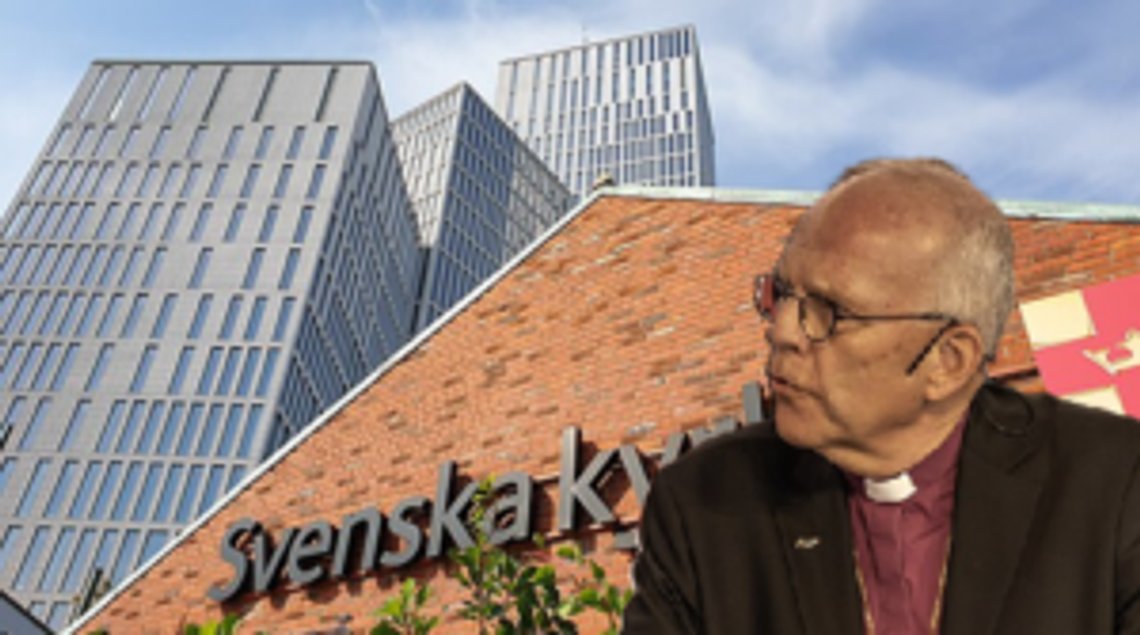
No. I admit it. The headline is not true. But it is half true—and it ought to be one hundred percent true. Because if the Archbishop is now urging Swedes to resist Christian nationalism, surely it must be time for the Church of Sweden to change its name—so that it is not perceived as too Swedish…?
Archbishop Martin Modéus launches a strong attack, in a long op-ed published in Dagens Nyheter, against what he calls “Christian nationalism,” a phenomenon he describes as “troubling” and one that, in his view, must be opposed.
One might ask why. How can the archbishop of one of the nation’s most traditional institutions — the national church, the Church of Sweden (Svenska kyrkan) — go on a frontal assault against nationalism? It soon becomes clear, however, that the archbishop has fundamentally misunderstood the concept.
“The first reason for the difficulties in reconciling Christian faith and nationalism can thus be seen in Jesus’ own way of encountering the people around him. […] He preached boldly and helped everyone who came to him — across human boundaries,” writes the archbishop.
Such compassionate behavior is thus presented as the opposite of nationalism.
In addition, Bishop Modéus argues that it can be “confrontational or problematic” if one perceives oneself as “Swedish” rather than as “human,” and that nationalism is “a form of tribal thinking, where like seeks like in hard or soft confrontation with the surrounding world.”
As an example of this, the archbishop cites — drumroll — Trump and the MAGA movement. Unexpected, right?
But does the archbishop really mean that a Christian person cannot be a nationalist and at the same time meet fellow human beings of different origins or faiths in a respectful and loving way?
The answer is a resounding “well… no.”
Apparently, one can be both Christian and nationalist. But there is a caveat:
“However, every Christian needs to stand before Jesus and ask for help in seeing their human and ideological choices in the light of who he is. And then we see that certain patterns of thought meet clear resistance.”
Anyone who has dealt with church representatives will likely nod in recognition at this phrasing, as it reflects a position that is a well-known source of conflict within Church of Sweden congregations. We are, of course, talking about the attitude: “I am right and you are wrong—but pray, and God may (perhaps) grant you the same insight that I already have.”
According to the archbishop, it is not possible to be a nationalist and at the same time be a Christian in the proper way. But for the person who “stands before Jesus” and “asks for help in seeing their choices,” the truth will be revealed and show that the “thought pattern” of nationalism is wrong.
Thus, when someone claims to be both Christian and nationalist, it is a sure sign to the outside world that the person has not seen the light.
The person may believe they are Christian—but they are not, not really. Not like the Good and Proper Ones. Those who think correctly.
“Revealed Values” are the Church of Sweden’s equivalent of the Pentecostal baptism of the Spirit.
The archbishop’s reasoning inevitably reminds me of my conversation with Imam Mahmoud Khalfi (the Muslim Brotherhood’s top figure in Sweden and a recurring collaborator of Archbishop Emerita Antje Jackelén). The imam informed me that I was, of course, free to choose to be a Christian — but that by doing so I was simultaneously choosing to end up in hell…
And yet, there is something peculiar about Bishop Modéus’s reasoning.
For the archbishop also claims to be “deeply grounded in love for Sweden.”
In other words: the archbishop himself is a nationalist.
That does him credit. And I admit it: I am also a nationalist. I love the country where I was born and raised in an entirely unique way. Wherever I may go on this earth, I will carry with me the nature, language, and traditions of my childhood closest to my heart.
“I long for the land, I long for the stones where as a child I played,” as Verner von Heidenstam put it.
Deep down, I will always love my fatherland the most, in exactly the same way as virtually all Norwegians, Finns, Danes, Britons, Poles, Ukrainians, Iranians, Iraqis, French, Turks, Kurds, Syrians, Afghans, Spaniards, Portuguese, Egyptians, Palestinians, Germans, Americans, Australians, Estonians, Icelanders, [fill in the blank], and everyone else I have ever met.
We are all nationalists.
This naturally raises the question of whether it is only Swedish Christian nationalism that is ugly and wrong, or whether this also applies to Christians from other nations. Perhaps the communications department should issue guidelines to congregations on how they should deal with the many Christians from other countries who attend services and parish activities? Are they allowed to be Christian nationalists?
Presumably, it is precisely the nationalism of Swedish Christians that the archbishop believes should be met with resistance. Christian Ukrainians, Palestinians, and Syrians will most likely still be allowed to express love for their nation.
And that is where things become even more complicated. For the archbishop also writes that theology “is opposed to all forms of tribal thinking.” In other words, dividing people into “us” and “them.” On this point, I agree with the archbishop one hundred percent: we are created as one single humanity. And yet, it is precisely this kind of tribal thinking that he himself expresses in his text, when time and again he divides his flock into different pens: there are those who love their country in the archbishop’s way—and then there are the others.
At this point, we have come full circle and can, somewhat surprisingly, conclude that the archbishop himself appears to be just as categorizing as the most hardline nationalist: he divides Christians into us and them, right and wrong, respectable Christians and disreputable Christians. Why?
And how on earth can a church that is supposed to “resist nationalism” continue to call itself the Church of Sweden? Is that not an expression of stale nationalism, as opposed to open globalism? Would it not be more honest (and better, judging by the archbishop’s reasoning) to change its name to something less exclusive and more accurate?
So many questions—so few answers.
But then it occurred to me!
It is an election year, after all, and voters must now be marinated in the message that nationalism is evil and that a good person distances themselves from nationalism—and therefore votes correctly (red).
The national people’s church’s rejection of nationalism came with the election eight months away.
There will be more to come.


