

The ministries have still not explained why calls and demands for improved police certificates for child welfare service staff have been ignored for years. The current system has contributed to criminals being able to work in close contact with minors.
It is only now that the Ministry of Justice is examining a proposal for a legislative amendment that would ensure all criminal offences are disclosed in police certificates for child welfare service staff.
In 2023, the Child Welfare Committee published the report ‘Safe Childhood, Secure Future’ (NOU 2023:7), in which the Ministry of Children and Families was asked to consider requiring a ‘comprehensive police certificate’ for all child welfare service staff.
Currently, only a limited certificate is required for ordinary staff. This certificate omits a number of criminal convictions from the national criminal records register.
Three years later, the Ministry of Children and Families has still not investigated the matter.
Background:
Violence, drugs and weapons lead to a clean police certificate in child welfare
In the Norwegian Child Welfare Services’ consultation response to the public inquiry, police certificates were not mentioned at all. This is despite the fact that, as early as 2020, the Storting specifically requested that the certificates must show all relevant offences when working with children.
The police’s criminal records unit in Finnmark wrote in its consultation response that it had no objections to the introduction of extended police certificates, but pointed out that this would result in more time-consuming case processing. As an example, they mentioned that in 2022, 18,007 applications for certificates were received from the child welfare sector.
The police also pointed out that stricter requirements would create more work for the prosecution service, as charges would have to be obtained from them.
In 2025, several amendments were made to the Child Welfare Act, specifically concerning the requirements for police certificates. However, for unknown reasons, the requirement for a certificate for ordinary child welfare staff was not tightened.
The specific proposal from the 2023 report regarding stricter requirements was not adopted.
Neither the Ministry of Justice and Public Security nor the Ministry of Children and Families has so far responded to Document’s questions:
– Why?
We have been informed that the Ministry of Justice’s proposal for changes to the system for child welfare certificates is now due to be put out for consultation ‘shortly’.
– Due to the work on this proposal, the Ministry of Children and Families decided, in its follow-up to the Child Welfare Committee’s report, to postpone changes to the rules on police certificates, in order to adopt a more up-to-date and coordinated approach to the issues,” says Rune Martin Akselsen, Communications Adviser at the Ministry of Children and Families.
– Based on the report, Økokrim and Bufdir have established closer cooperation. Bufdir will also assess who should check the certificates and how often this should take place.
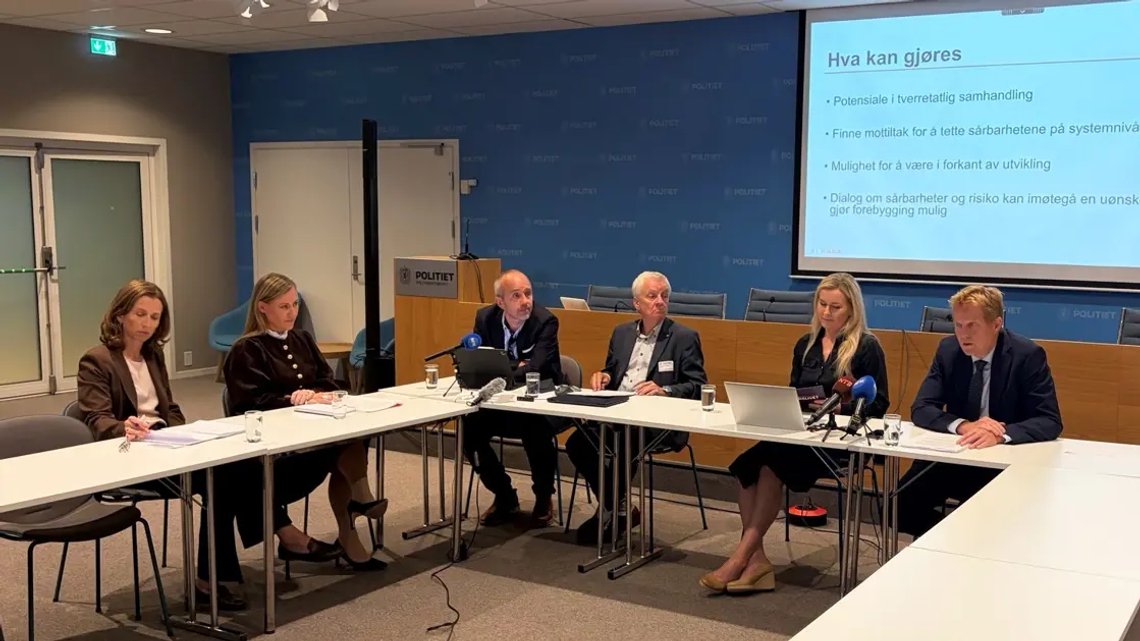
The West Police District’s recent threat assessment for the period 2026–27 highlights another shortcoming in the background checks carried out by the child welfare services. It refers to a Swedish national who threatened a minor resident at the institution where he worked, because he allegedly owed him money.
In Sweden, he had previously been charged with both drug offences and acts of violence. In Norway, therefore, the Norwegian police certificate presented at the time of his appointment did not reveal his background.
The man was charged with making threats and drug offences.
– Far too long
– There is no doubt that this has taken far too long, said the deputy chair of the Children and Families Committee, Mats Henriksen (FrP), in a parliamentary debate in October.
– At the same time, it is important that a police certificate does not provide a false sense of security. The police may have information about criminal networks that will never appear on the certificate, he said.
It was not until the summer of 2024 that a requirement was introduced for managers and owners of child welfare institutions to present an extended police certificate when entering into a contract with Bufetat or the municipal child welfare service.
One of the factors that enabled two child welfare facilities run by BevisstUng Bolig AS in Drammen to have convicted criminals amongst their staff was that they did not need to produce full police certificates.
The scandal came to light when the police tipped off Bufetat, which then launched its own investigations.
Will investigate employment bans
The Child Welfare Committee also proposed that there should be a requirement for regular updating of certificates and called for an investigation into the duty of notification to the Health Supervisory Authority for child welfare staff, with a view to being able to ban certain individuals from working in child welfare.
The report contained nearly 120 proposals for measures.
Kjersti Toppe of the Centre Party called for a complete reorganisation when the Storting debated the matter.
– The Minister has said in an interview that reorganisation is not what is needed, but I believe that is precisely what is required. The Minister says we must leave no stone unturned, but the stones have already been turned, and we cannot clearly see the systemic failure lying beneath them.
Tone Wilhelmsen Trøen from the Conservative Party said that the party now has ‘a rather frayed confidence that the government will sort things out’.
– We need to tackle this now and, if necessary, use this report and the Stene Committee’s report to quickly sort things out and get this situation under control, because it is extremely serious.
In the government’s draft budget for 2027, the Labour Party is proposing over 700 million kroner in additional funding for the state child welfare service and for the procurement of private services, Minister for Children and Families Lene Vågslid stated during the debate.
Documents: unanswered questions to the ministries
In June 2025, the Ministry of Children and Families presented a proposal for legislative amendment in Prop. 83 L concerning quality improvements in child welfare services. Proposal 105 from NOU 2023:7 was not adopted, even though the Ministry acknowledged a request from the Norwegian Directorate for Children, Youth and Family Affairs (Bufdir) to strengthen the requirement also for measures such as child welfare institutions.
The Child Welfare Act was amended, but not in Section 12-11, second paragraph. There, the restricted child care certificate still applies to staff at child welfare institutions and municipal residential facilities.
An amendment was made to Section 12-11, eighth paragraph, second sentence, but this applies only to foster parents and respite care homes, not to staff at child welfare organisations.
In 2023, the committee therefore recommended investigating stricter requirements, a move supported by the police, amongst others. Nevertheless, the Ministry chose to retain the restricted type of certificate, even though the law was amended in 2025.
– Why?